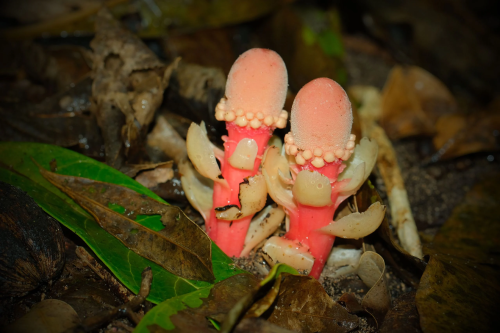
A plant that looks more like a mushroom than traditional greenery is capturing the attention of scientists worldwide. Balanophora, a rare parasitic species found in the forests of Okinawa, challenges almost every conventional rule of botany.
Unlike typical plants, Balanophora has no leaves, no roots, and no chlorophyll, making it incapable of photosynthesis. Instead, it survives by attaching to the roots of nearby trees and siphoning nutrients directly from its hosts. Some species even reproduce underground through obligate agamospermy, bypassing pollination entirely, a reproductive method rarely seen in the plant kingdom.
A new study by researchers at the Okinawa Institute of Science and Technology has shed light on the plant’s remarkable biology. Although Balanophora appears highly reduced and fungus-like, it retains tiny plastids—cellular structures usually involved in photosynthesis. Surprisingly, these plastids contain only 20 genes (compared to the usual 200 in plants) but import over 700 proteins, suggesting they play vital metabolic roles despite the plant’s parasitic lifestyle.
Dating back over 100 million years, Balanophora represents an ancient lineage and is considered a living fossil. Its survival, however, is precarious. Restricted to specific island forests and reliant on select host trees, the plant faces mounting threats from habitat loss and climate change, leading conservationists to classify it as critically endangered.
Balanophora is more than a botanical curiosity—it is a window into evolutionary history, demonstrating how life can radically adapt and survive under unusual ecological conditions. Scientists warn that protecting its fragile habitat is essential to preserving this extraordinary survivor of the plant world.