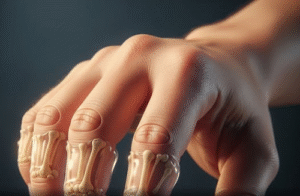
In a groundbreaking achievement that could redefine human medicine, Australian scientists have successfully regrown amputated human fingers by activating genes that humans naturally possess but have long left dormant. The discovery leverages insights from salamander biology, demonstrating that humans carry the genetic blueprint for limb regeneration, previously thought exclusive to certain amphibians.
The research, conducted by leading regenerative medicine teams in Australia, uses a bioactive gel containing proteins derived from axolotl salamanders, famous for their remarkable regenerative abilities. Applied to amputation sites, the gel triggers the formation of a blastema, a mass of stem-like cells capable of rebuilding bone, muscle, nerves, tendons, blood vessels, and functional skin layer by layer.
Patients treated with the gel have reportedly regrown fully functional fingers within four to six months, restoring not only appearance but also sensation and mobility. So far, the treatment has been used to successfully regenerate 340 amputated fingers and toes, marking a historic milestone in human regenerative medicine.
Scientists explain that adult humans naturally suppress these regenerative genes, such as MSX1 and other developmental transcription factors, in favor of rapid scar formation. By reactivating these pathways, the treatment induces mature cells to dedifferentiate into embryonic-like states, reconstructing complex tissues in the precise anatomical order of the original digit.
“This work demonstrates that humans are not fundamentally incapable of regeneration,” said a lead researcher. “We’ve simply evolved to repair injuries with scar tissue instead of rebuilding entire structures. By borrowing cues from salamanders, we can awaken these latent capabilities.”
The breakthrough has generated excitement but also skepticism and ethical debate. Some prosthetics manufacturers and reconstructive surgeons express concern that the technology could disrupt existing medical industries. Bioethicists question whether reactivating ancient regenerative programs might carry unforeseen consequences, potentially returning humans to “primitive” biological states evolution intentionally suppressed.
Meanwhile, the military sector has expressed interest in the technology for treating wounded soldiers, raising questions about dual-use applications, including whether enhanced regenerative abilities could alter standards of battlefield survivability.
Despite these debates, the potential applications of this discovery are staggering. Beyond fingertip regeneration, researchers envision treatments for more complex limb injuries, spinal cord injuries, and degenerative conditions, potentially ushering in a new era where the human body can heal itself in ways previously relegated to science fiction.