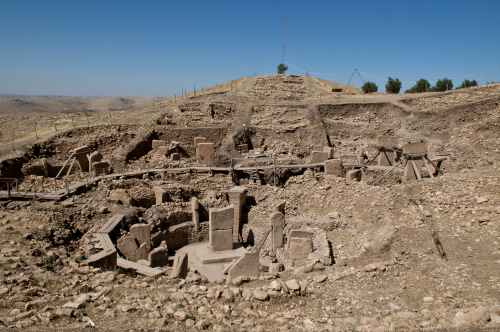
Archaeologists and historians around the world are fascinated by the discovery of the monumental Göbekli Tepe pillars, located near the city of Şanlıurfa in southeastern Turkey. These massive stone structures, carved intricately with animal figures and abstract symbols, date back an astonishing 9,500 years—around 9,500 B.C.—making them far older than any known writing system, city, or even the famous Egyptian pyramids.
Göbekli Tepe is widely regarded as one of the earliest examples of monumental architecture in human history. The site consists of numerous circular and rectangular enclosures, each containing towering T-shaped pillars that rise several meters into the sky. Some of these pillars are adorned with detailed carvings depicting animals such as lions, snakes, boars, and birds, hinting at complex spiritual or ritualistic practices of the prehistoric people who constructed them.
The discovery of Göbekli Tepe challenges long-held assumptions about the development of human civilization. Traditionally, scholars believed that agriculture, cities, and writing were prerequisites for large-scale construction projects. However, Göbekli Tepe demonstrates that prehistoric humans could organize, plan, and execute monumental construction projects long before settling into permanent communities or developing written language.
Excavations continue at the site under the supervision of Turkish and international archaeologists. Researchers hope that further studies will shed light on the purpose of the site, the social structure of its builders, and the technological innovations that allowed humans to achieve such architectural feats 11,500 years ago.
Göbekli Tepe’s significance extends beyond Turkey, offering an unparalleled glimpse into early human ingenuity and spirituality. As more discoveries emerge, this ancient site continues to redefine the narrative of human history, proving that our ancestors were far more sophisticated than previously imagined.