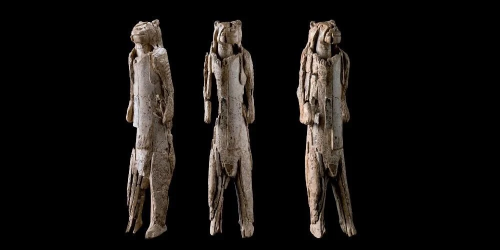
In a remarkable discovery that has fascinated historians and archaeologists worldwide, the iconic Lion-Man sculpture, carved from mammoth ivory, has been dated to approximately 38,000 B.C. This stunning artifact, found in the Hohlenstein-Stadel cave near Ulm, Germany, represents a unique blend of human and animal features, combining the body of a human with the head of a lion.
Experts suggest that the Lion-Man could be the earliest known representation of a mythological figure, predating not only recorded history but also agriculture, pottery, and the rise of civilization itself. The precision and craftsmanship of the sculpture indicate that early humans possessed advanced artistic skills and a sophisticated understanding of symbolism and spiritual belief systems.
Measuring over 30 centimeters tall, the sculpture was meticulously carved from a single piece of mammoth ivory. Despite the challenges posed by the material and primitive tools, the creators managed to detail the figure with remarkable intricacy, reflecting early humans’ imagination and reverence for the natural world.
Archaeologists believe that the Lion-Man may have played a role in rituals or storytelling, serving as a bridge between humans and the animal kingdom in the spiritual or cultural life of Ice Age societies. Its discovery continues to inspire debates about the origins of religion, mythology, and human creativity, offering a rare glimpse into the minds of our distant ancestors.
The Lion-Man stands today not only as an archaeological treasure but also as a powerful testament to humanity’s enduring capacity for imagination, art, and symbolic thought, reminding us that even tens of thousands of years ago, humans were exploring concepts that resonate deeply with modern culture and belief.