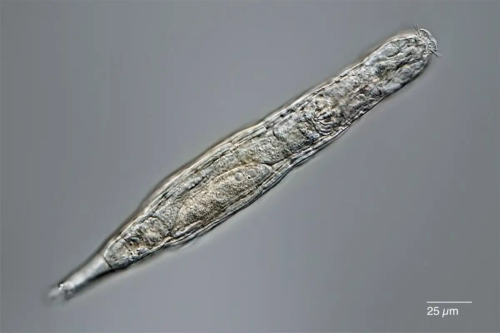
In a discovery that blurs the line between life and death, scientists have successfully revived microscopic multicellular animals that had been frozen in the Siberian permafrost since the late Pleistocene epoch. The creatures, known as bdelloid rotifers, were brought back to life after spending roughly 24,000 years in a deep-freeze alongside woolly mammoths.
The breakthrough, led by the Soil Cryology Laboratory at the Institute of Physicochemical and Biological Problems in Soil Science, was detailed in the journal Current Biology. It marks the longest recorded survival of a rotifer in a frozen state, shattering the previous belief that these organisms could only survive freezing for about a decade.
The rotifers survived the millennia by entering a state called cryptobiosis—a biological “pause button” where metabolism almost completely stops. In this state, the organisms are neither truly alive nor dead, allowing them to withstand extreme conditions like dehydration, starvation, and sub-zero temperatures. Researchers collected the samples from a depth of 3.5 meters near the Alazeya River in northeastern Siberia. Radiocarbon dating confirmed the soil and the organisms within it were approximately 24,000 years old.
From Thaw to “Baby Boom”
The most startling aspect of the revival was the speed at which the organisms recovered. Once the permafrost was slowly thawed in a laboratory petri dish:
Immediate Activity: The rotifers resumed feeding on bacteria within hours.
Asexual Reproduction: As bdelloid rotifers are an all-female species, they immediately began reproducing through parthenogenesis (cloning themselves).
Generation Gap: The new offspring are genetic clones of parents that lived tens of thousands of years ago.
While scientists have previously revived 30,000-year-old nematodes (roundworms) and ancient mosses, rotifers are significantly more complex. Despite their microscopic size, they possess a brain, a gut, and a nervous system. “The takeaway is that a multicellular organism can be frozen and stored as such for thousands of years and then return back to life—a dream of many fiction writers,” said lead researcher Stas Malavin.