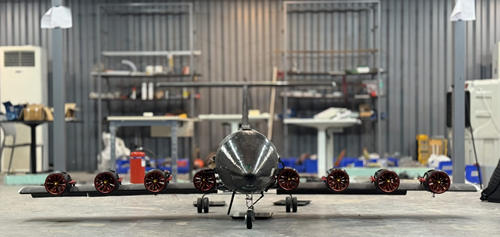
In a bold leap from food delivery to futuristic flight engineering, Zomato Co-Founder Deepinder Goyal has officially ventured into the aerospace sector through his new startup, LAT Aerospace. The company is already making headlines with the development of its first fully-electric, fixed-wing unmanned aerial vehicle (UAV) — a breakthrough that could reshape India’s aviation and drone ecosystem.
Built entirely from scratch, the prototype aircraft has been engineered inside LAT’s state-of-the-art flight lab. The UAV comes equipped with uSTOL (ultra Short Take-Off and Landing) technology, enabling it to lift off in as little as 40 meters — a remarkable feat in electric aviation. Once in the air, it can fly for 60 minutes and travel autonomously between major cities, including the impressive capability to cruise from Mumbai to Pune without manual intervention.
Industry experts say LAT’s innovation reflects a growing trend of Indian entrepreneurs pushing boundaries in high-tech engineering. Goyal’s move into aerospace has sparked excitement among both tech enthusiasts and investors, who view this as a daring step toward India’s future in drone logistics, surveillance, and autonomous mobility.
LAT Aerospace isn’t stopping at electric UAVs. The engineering team is already working on hybrid-electric propulsion systems and gas turbine engines, aiming to position India as a global competitor in next-generation aviation technologies. These advancements could significantly impact defense, disaster response, cargo delivery, and environmental monitoring sectors.
Deepinder Goyal’s entry into aerospace marks a powerful message: innovation knows no boundaries. From transforming food delivery through Zomato to tackling the complexities of flight engineering, he is once again proving that Indian entrepreneurs are ready to build the technologies of tomorrow.
As LAT Aerospace prepares for its first test flights, the aviation world is watching closely — and India may be on the verge of its next big aerospace revolution.