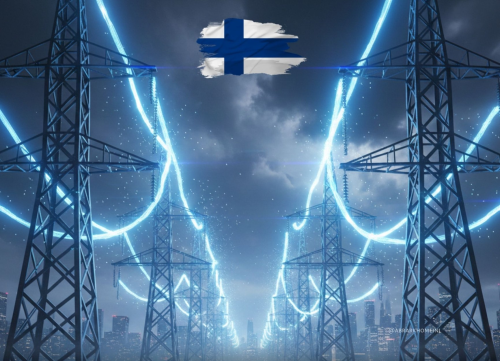
A stunning image showing Finland beaming electricity wirelessly across entire cities has taken the internet by storm — but experts say the viral claim is pure myth, not modern engineering. Despite the breathtaking visuals circulating online, Finland has not replaced its national power grid with wireless, cable-free electricity transmission.
Multiple energy researchers have confirmed that such a feat, while conceptually linked to Nikola Tesla’s century-old ambitions, remains far beyond current technological capability. The reason is simple: delivering power wirelessly at the scale of gigawatts, safely and efficiently, is still impossible without massive energy losses and dangerous radiation levels.
But dismissing the viral claim does not mean Finland is standing still. In fact, the country remains one of the world’s most forward-thinking energy innovators, leading breakthroughs that may someday form the foundation for a cable-free future.
One of the biggest players in this space is Nokia, which is developing AI-optimized systems to dramatically reduce energy consumption in 5G networks. These systems can adjust power use in real time — cutting waste and supporting Finland’s push toward carbon-neutral connectivity. Experts say improving efficiency is the first realistic step before any future wireless power revolution.
Meanwhile, practical wireless power technology is quietly advancing across the globe. It’s already in everyday life — powering smartphones through inductive charging pads. And the next major leap is underway:
Wireless dynamic road charging, where electric vehicles charge while driving via power strips embedded in highways. Several European companies are piloting these systems, viewing EV mobility as the most achievable arena for near-term wireless energy transfer.
Unlike the dramatic “city powered by air” narrative, these innovations focus on solving the real challenges — energy loss, safety, scalability, and infrastructure cost.
Experts emphasize that while a fully wireless power grid remains in the distant future, the incremental technologies being developed today are laying the stepping stones for tomorrow.