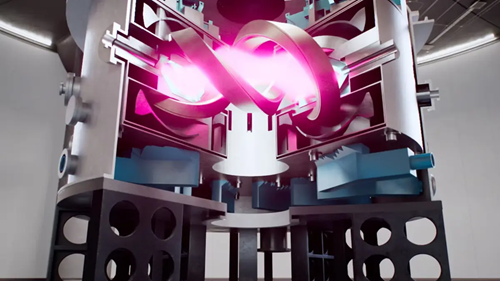
In a groundbreaking advancement for clean energy, Japan has successfully tested the world’s first high-temperature superconducting coil capable of withstanding the extreme conditions inside a nuclear fusion reactor — marking a critical step toward achieving limitless, zero-carbon power.
The test, conducted by Japanese startup Helical Fusion, represents the first time a large-scale superconducting coil has operated under reactor-level heat and magnetic stress, enduring currents of around 40,000 amps and magnetic fields reaching 7 tesla at temperatures near –258°C.
This technological breakthrough brings Japan significantly closer to creating stable, continuous plasma, the core process required to generate fusion energy — the same power that fuels the sun. Fusion energy promises to deliver a virtually infinite, clean, and sustainable source of power, without the radioactive waste associated with traditional nuclear fission.
Helical Fusion’s success now sets the stage for the development of its next major project, the “Helix HARUKA” demonstration reactor, which aims to achieve uninterrupted operation and net-positive energy output — producing more energy than it consumes.
“This achievement proves that superconducting technology can perform reliably under fusion-relevant conditions,” said a Helical Fusion spokesperson. “It’s a step not just for Japan, but for the global pursuit of clean, limitless energy.”
If successfully scaled, the technology could redefine global energy systems, marking a historic milestone in humanity’s decades-long effort to unlock the power of the stars and end reliance on fossil fuels.