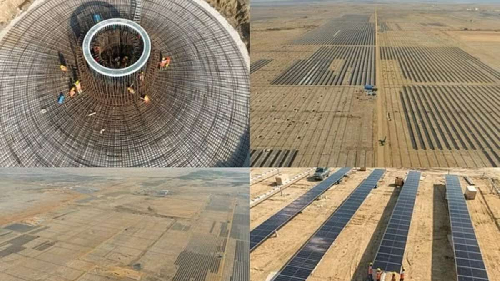
India is making a monumental stride in clean energy with the construction of the Khavda Renewable Energy Park in the desolate, arid expanse of the Rann of Kutch. Set to become the world’s largest renewable energy installation, the hybrid park boasts a planned capacity of 30 Gigawatts (GW) of solar and wind power.
Spanning over an enormous area of 72,600 hectares (or 726 square kilometers), the project’s size is comparable to the entire land area of the nation of Singapore (approximately 719 square kilometers).
The park, which saw its foundation stone laid in 2020 by Prime Minister Narendra Modi, represents a critical element of India’s ambitious target to achieve 500 GW of non-fossil fuel energy capacity by 2030.
- Capacity Breakdown: The 30 GW capacity is a hybrid of solar and wind energy, maximizing power generation throughout the day and night.
- Massive Scale: The land area is approximately five times the size of the city of Paris, showcasing the sheer scale of India’s commitment to renewable sources.
- Green Impact: Once fully operational, the project is expected to generate enough clean electricity to power over 16 million homes annually and help avoid approximately 58 million tonnes of CO2 emissions each year.
- Strategic Location: Located near the Indo-Pakistan border, the Kutch region was chosen due to its favorable conditions, boasting high solar irradiation and excellent wind speeds, making it an ideal site for giga-scale renewable energy development.
The Khavda Renewable Energy Park is being developed by a consortium of companies, including Adani Green Energy Limited (AGEL), NTPC, and others, with an estimated investment of over ₹1.5 lakh crore (approx. $18 billion).
This monumental project not only sets a new global benchmark for clean energy but also promises to create over 100,000 jobs and contribute significantly to local economic development in the Kutch district. The park is already beginning to feed power into the national grid, marking a tangible milestone in India’s energy transition.
The successful completion of the Khavda Park will solidify India’s position as a global leader in renewable energy deployment, demonstrating how large-scale sustainable projects can be effectively implemented even in challenging terrains.