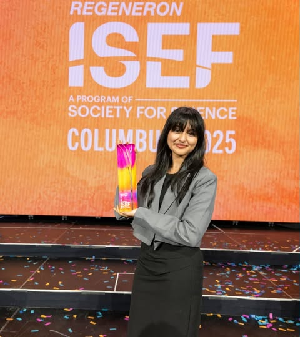
Siyaa R. Poddar, a 16-year-old from Chandler, Arizona, has been awarded a prestigious $75,000 Regeneron Young Scientist Award for creating an innovative, low-cost device capable of detecting invisible and highly toxic air pollutants. The honor was bestowed at the 2025 Regeneron International Science and Engineering Fair (ISEF), the world’s largest pre-college STEM competition.
Poddar’s breakthrough device, named RADAR, is designed to rapidly detect toxic dusts like silica and uranium—pollutants from abandoned mines that pose a severe public health risk in the U.S. Southwest, particularly to Indigenous communities. Inhalation of these toxins is linked to a disproportionately high rate of autoimmune diseases, such as Sjögren’s Syndrome.
The core of Poddar’s invention is a novel solid-substrate colorimetric material. She used specialized chemicals embedded within a stable, porous structure called a Metal-Organic Framework (MOF). When exposed to the air, the films undergo a visible color shift in as little as 15 minutes if silica or uranium are present.
Existing detection methods are often expensive, slow, and lab-dependent, leading to significant delays in diagnosis for related illnesses. Poddar’s system offers an affordable and easy-to-use alternative for early environmental screening.
The 16-year-old’s research paper, titled “Real-time Assessment of Deteriorative Airborne Risks,” detailed the device’s ability to provide statistically significant detection of the toxins, offering a promising tool to reduce diagnostic delays and improve health outcomes in underserved communities.