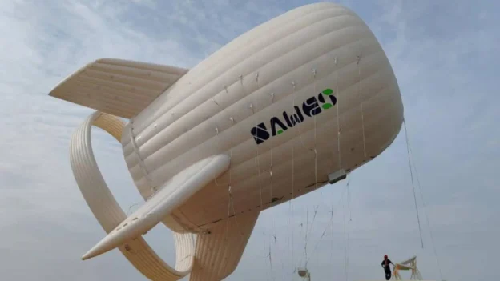
China has taken a major step forward in the race to harness high-altitude wind energy, with its S500 buoyant airborne wind turbine system successfully generating electricity at an unprecedented altitude of 500 meters during a recent test flight. The achievement, a collaboration between Beijing SAWES Energy Technology Co., Ltd., Tsinghua University, and the Aerospace Information Research Institute, sets a new benchmark for airborne wind power.
Unlike traditional wind turbines that are limited to lower altitudes, the S500 system uses a helium-filled blimp to lift a lightweight turbine to a height where winds are significantly stronger and more consistent. During its test in Jingmen, Hubei province, the S500 generated over 50 kilowatts of power, demonstrating the viability of a technology that could revolutionize renewable energy access in remote or disaster-stricken areas.
The principle behind the S500 is deceptively simple: tap into the vast and powerful energy source of high-altitude winds. According to SAWES, winds at a height of 500 meters are much stronger than those on the ground, allowing for a more efficient and stable power supply. The electricity generated in the airship is transmitted to the ground via a power cable tethered to a base station.
This successful test flight is a crucial step in China’s ambitious airborne wind energy program. The S500 is a prototype for a series of more powerful systems, including the S1000, which has already been tested at 1,000 meters and generated over 100 kW, and the S1500, a megawatt-class system that is currently being prepared for flight testing. The ultimate goal is to develop systems that can operate at altitudes of up to 10,000 meters, where wind speeds are up to 200 times stronger than on the surface, offering a potentially game-changing source of clean energy.
The technology’s mobility and rapid deployment capabilities are a key selling point. SAWES officials note that the S500 could be quickly launched to provide power and communication in the aftermath of natural disasters like earthquakes or floods, where traditional infrastructure has been destroyed. It also offers a cost-effective alternative for supplying power to islands, remote communities, and isolated industrial sites.