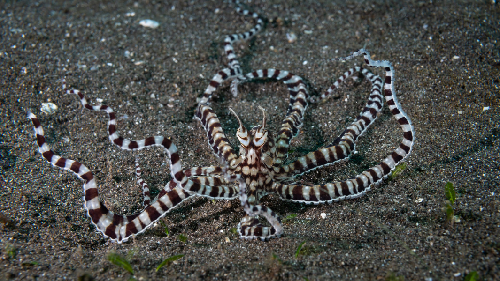
The marine world has a new star of disguise: the Mimic octopus, a curious creature that can transform its appearance to impersonate a startling array of marine animals. Discovered in 1998 off the coast of Sulawesi, Indonesia, this cephalopod has astounded scientists with its ability to not just camouflage, but to actively shapeshift and imitate other species.
Unlike most animals that rely on a single form of mimicry, the mimic octopus is a master of “dynamic mimicry,” intelligently selecting its disguise based on the perceived threat. When faced with a predatory damselfish, the octopus will impersonate its own predator, the venomous banded sea snake, by pulling six of its arms out of sight and stretching the remaining two in opposite directions. To ward off a different predator, it might splay its arms to mimic the spines of a poisonous lionfish or flatten its body and tuck in its arms to glide along the seafloor like a toxic flatfish.
This remarkable intelligence and adaptability allow the mimic octopus to survive in its unique habitat of muddy river mouths and estuaries, where traditional hiding spots like coral reefs are scarce. By impersonating up to a dozen different species, the octopus can both evade danger and lure unsuspecting prey, making it a true marvel of evolution and a testament to the incredible creativity found in nature.