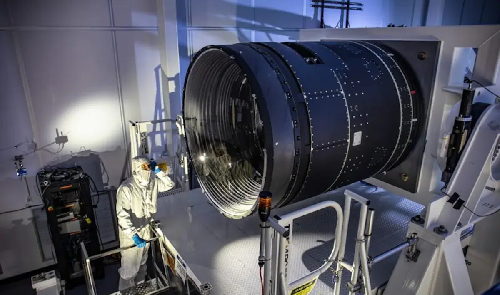
The world’s largest digital camera has captured a breathtaking image of the universe with an astonishing resolution of 3,200 megapixels — the highest ever recorded for a single photograph of the cosmos.
Developed for the Vera C. Rubin Observatory in Chile, the camera is a key component of the Legacy Survey of Space and Time (LSST), a decade-long astronomical project. Weighing over 3 tonnes and roughly the size of a small SUV, this state-of-the-art instrument will map billions of galaxies, detect faint asteroids, and help unravel dark matter and dark energy mysteries.
What makes this camera truly remarkable isn’t just its resolution, but its ability to capture minute celestial details — so sensitive that it could spot a golf ball from 24 kilometers away. Each image it produces is so massive, it would require 378 ultra-HD 4K TVs to display at full size.
The observatory’s science team confirmed that the first full-sky surveys will begin in 2025, marking a revolutionary leap in space imaging and data analysis.
“This is a game-changer for astronomy,” said project scientist Dr. Steven Kahn. “We’re not just photographing the sky — we’re charting the history and future of the universe.”
The LSST will capture a new image of the entire southern sky every few nights for ten years, generating a vast data set that will likely lead to unprecedented discoveries in astronomy.