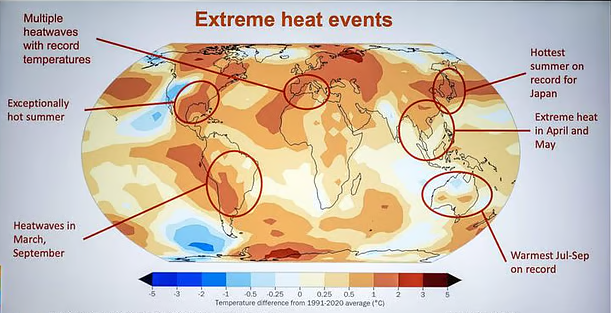
In a stark warning to the world, the United Nations’ World Meteorological Organization (WMO) officially confirmed on Tuesday that 2023 was the hottest year ever recorded, solidifying the past decade (2014–2023) as the warmest in human history.
The findings were published in the WMO’s State of the Global Climate 2023 report, which stated that heat records were “smashed” globally last year. Scientists documented intense heatwaves on both land and sea, leading to unprecedented glacier melt, marine heatwaves, and cascading effects on biodiversity, agriculture, and water systems.
“Climate change is not a distant threat. It is here. It is accelerating. And it is impacting every corner of our planet,” said WMO Secretary-General Petteri Taalas.
Key highlights from the report include:
- Global average temperature in 2023 was around 1.45°C above pre-industrial levels, dangerously close to the 1.5°C limit set by the Paris Agreement.
- Oceans absorbed over 90% of the excess heat, leading to widespread coral bleaching and marine ecosystem stress.
- Antarctica and Alpine glaciers suffered record ice loss, with implications for global sea levels and freshwater systems.
The WMO warned that unless urgent global action is taken to reduce greenhouse gas emissions and transition to sustainable energy systems, future years could surpass 2023 in heat intensity and environmental impact.
The report serves as a call to action for world leaders ahead of upcoming climate negotiations, with scientists emphasizing that the window to avoid irreversible damage is rapidly closing.