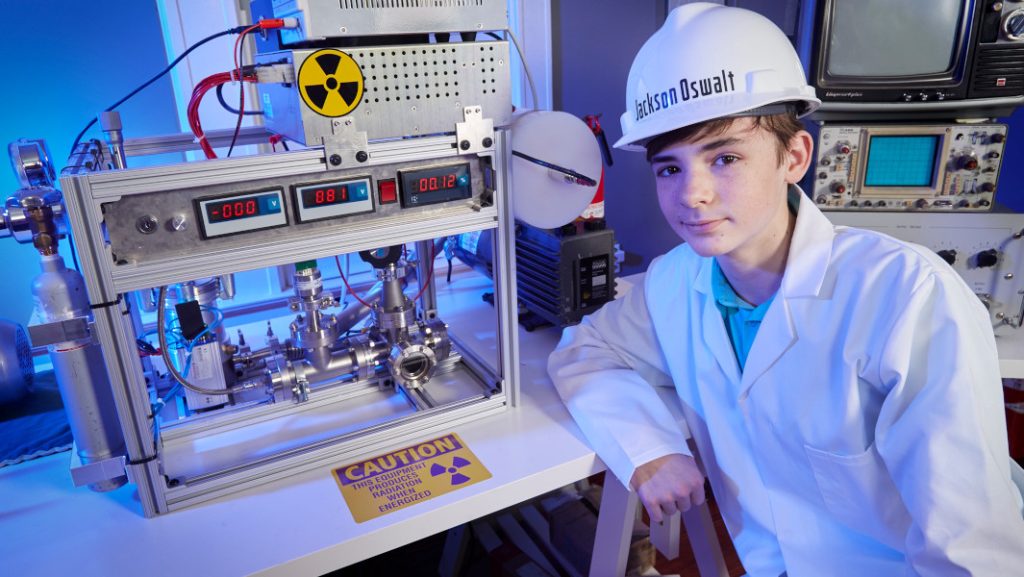
A 12-year-old boy from the United States recently made headlines for achieving a groundbreaking scientific feat: nuclear fusion in his own playroom. This remarkable accomplishment caught the attention of experts and led to a visit from the FBI due to the potential implications of such an achievement.
The Boy’s Name: The young inventor, whose identity has been kept private in many reports, is a 12-year-old science enthusiast with a passion for physics and engineering.
The boy managed to achieve nuclear fusion, the process in which atomic nuclei combine to form a heavier nucleus, releasing a significant amount of energy. This is the same process that powers the sun and other stars.
He accomplished this by building his own fusion reactor in his playroom using common materials and equipment he found or purchased online, showcasing an extraordinary level of ingenuity for someone so young.
Given the sensitive nature of nuclear fusion, which is usually only achieved in highly controlled and regulated environments such as government labs or large research facilities, the boy’s achievement raised concerns about safety and national security.
The FBI reportedly visited the boy’s home to investigate the situation and ensure there were no illegal activities or safety risks involved. They confirmed that while the boy’s project was impressive, there were no illegal intentions, and everything was contained within his personal workspace.
The young scientist expressed that his goal was not to create a weapon or dangerous device, but rather to explore the process of nuclear fusion for educational purposes. His curiosity about energy generation and physics drove him to experiment in a way that many adults and professionals might never attempt.
The boy’s story has caught the attention of educators and science communities, leading to discussions about home-based learning and the growing accessibility of advanced scientific tools. His achievement has sparked conversations about how young people are increasingly able to engage in sophisticated scientific experiments thanks to the internet and online resources.
Fusion Reaction: In fusion, light atomic nuclei, typically isotopes of hydrogen such as deuterium and tritium, collide at high speeds and fuse together, forming a heavier nucleus and releasing energy. This is the opposite of nuclear fission, the process used in conventional nuclear power plants, where large atomic nuclei are split to release energy.
Energy Production: Achieving controlled nuclear fusion is seen as the holy grail of energy production, as it could provide a nearly limitless, clean energy source. However, it’s a process that has so far only been achieved at a commercial scale in highly specialized facilities, and scientists around the world are still working on making it viable for widespread use.
Innovative Thinking: This young boy’s achievement highlights the power of curiosity and self-driven learning. His ability to tackle a complex scientific challenge shows how motivated individuals, regardless of age, can push the boundaries of what’s possible.
Growing Interest in DIY Science Projects: The rise of maker culture and online science communities has made advanced science more accessible to hobbyists and students. The boy’s story illustrates how tools that were once only available in high-tech laboratories are now accessible to the public, allowing people to experiment with cutting-edge science from their homes.
Safety and Regulation Concerns: While the boy’s work was not illegal, his achievement underscores the importance of safety when engaging with potentially dangerous scientific experiments, particularly those involving high-energy reactions. Nuclear fusion, although much safer than fission, still requires careful handling of equipment and materials to avoid accidents.
The story of this 12-year-old boy achieving nuclear fusion in his playroom is a fascinating reminder of the boundless potential of young minds. While it also raises important questions about safety, regulation, and the accessibility of scientific knowledge, it’s a testament to the power of curiosity and innovation. This boy’s experiment is a glimpse into the future of science and technology, where young, talented individuals might lead the way in breaking through some of the world’s most complex scientific challenges.