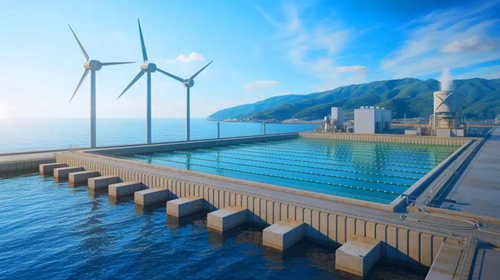
Japan has officially unveiled one of the most promising breakthroughs in renewable energy: salinity gradient power, a groundbreaking system that generates electricity simply by mixing saltwater and freshwater. This innovative technology harnesses the natural difference in salt concentration that occurs where rivers meet the sea, converting this chemical potential into clean, continuous power.
Scientists at Japan’s National Institute of Advanced Industrial Science and Technology (AIST) are behind this pioneering osmotic energy conversion method. Their research has culminated in a practical system poised to redefine the landscape of global energy production. Unlike intermittent renewable sources such as solar and wind energy, salinity gradient power does not depend on sunlight, wind patterns, or weather conditions. This makes it a uniquely reliable energy source, capable of operating 24 hours a day, seven days a week, and providing constant baseload electricity – a critical component for stable power grids.
Experts are already hailing the technology’s immense potential. Initial estimates suggest that if fully implemented worldwide, exploiting just river estuaries could generate up to 15% of the planet’s total energy demand. This significant contribution could drastically reduce reliance on fossil fuels and accelerate the global transition to a sustainable energy future.
The process itself is remarkably clean and efficient. It operates silently and is entirely emission-free, utilizing advanced membrane-based systems that selectively separate salt ions to produce an electric current. This sustainable approach minimizes environmental impact while maximizing energy output. Japan’s innovation is expected to reshape how nations perceive and implement renewable energy strategies. By transforming coastlines and river mouths into massive, silent power plants fueled entirely by nature’s chemistry, the technology offers a compelling solution to the world’s growing energy needs. The implications are profound, offering a path towards energy independence and a greener planet for generations to come.