A revolutionary class of heavy machinery, known as the Self-Propelled Modular Transporter (SPMT), is redefining the limits of what can be transported on land. These colossal, driverless machines are specifically engineered to lift and move some of the heaviest man-made structures on Earth with millimeter precision.
The SPMT is not a single vehicle but a matrix of interconnected, computer-controlled modules.
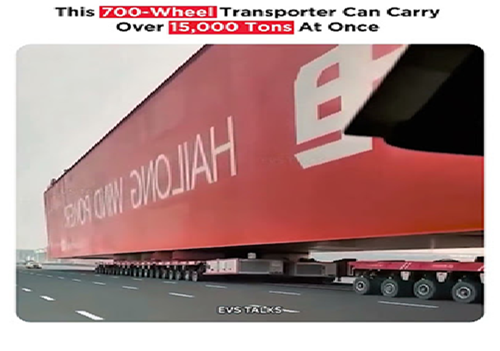
Massive Capacity: A typical SPMT configuration, like the one described, can feature up to 700 wheels and is designed to handle loads of up to 15,000 tons—a capacity high enough to move entire bridge sections, colossal wind turbine components, or massive shipyard modules.
360° Mobility: The defining feature of the SPMT is its unparalleled maneuverability. Every single wheel unit can steer 360 degrees, allowing the vehicle to move laterally, diagonally, or pivot in place.
Centralized Control: A sophisticated central hydraulic system controls all wheel units. This system is crucial for distributing the weight of thousands of tons evenly across all axles, preventing structural stress on the load and the ground beneath.
Driverless Operation: The absence of a traditional driver is key. The machine is fully self-propelled and controlled remotely or autonomously, showcasing advanced automation in heavy logistics.
Powering the Next Generation of Energy
The specific movement mentioned in this context is part of the Hailong Wind Power Project, an initiative focused on developing next-generation offshore energy infrastructure. Moving the immense, pre-fabricated components for such projects requires the kind of controlled, heavy-duty logistics that only SPMTs can provide.
The SPMT represents the pinnacle of modern engineering and automation, demonstrating how technology can move multi-thousand-ton structures with accuracy measured in millimeters, drastically simplifying the construction and assembly of megaprojects worldwide.