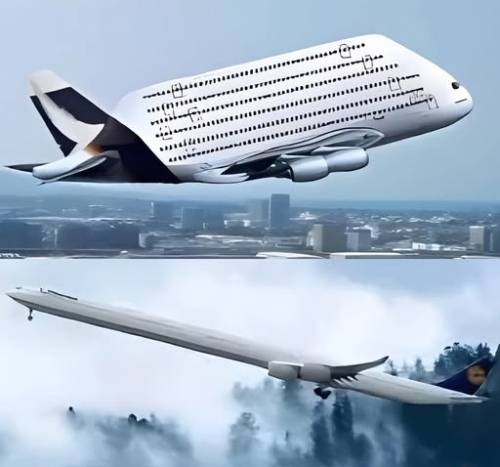
Designing massive aircraft such as the Airbus A380 or the Boeing 747 represents one of the most extreme challenges in modern engineering. Contrary to popular belief, physics does not forbid building even larger airplanes. Instead, the real obstacle lies in the exponential growth of complexity that comes with every additional meter of wingspan and every extra ton of weight.
As aircraft scale up, structural demands increase dramatically. Engineers must develop materials capable of withstanding immense stress while remaining lightweight enough to maintain efficiency. Wings must flex without failing, fuselages must endure repeated pressurization cycles, and landing gear systems must support colossal loads during takeoff and landing. Each of these requirements becomes more difficult and costly as size increases.
Beyond engineering, infrastructure presents another major limitation. Airports around the world are built to standardized dimensions, with fixed-width taxiways, specific gate sizes, and runway length limits. Accommodating “mega jets” often requires extensive and expensive upgrades, costing billions of dollars. Only a limited number of airports were able to fully support the Airbus A380, significantly restricting where airlines could operate the aircraft.
The A380 was once celebrated as the future of air travel, promising unmatched passenger capacity and comfort. However, market realities told a different story. Airlines increasingly favored smaller, more fuel-efficient twin-engine aircraft such as the Boeing 787 and Airbus A350. These planes offered long-range capability, lower operating costs, and the flexibility to fly directly between more city pairs without relying on large hub airports.
Economic efficiency ultimately proved more important than sheer size. While larger aircraft can carry more passengers, filling every seat consistently is challenging, and operating partially full mega planes quickly becomes unprofitable. Smaller wide-body jets provide airlines with better load management, reduced fuel consumption, and greater route versatility.
Today’s aviation industry reflects a shift in priorities. Success is no longer measured by how big an aircraft can be, but by how intelligently it is designed. Advances in aerodynamics, composite materials, and engine efficiency have made it possible to do more with less, delivering better performance without increasing size.