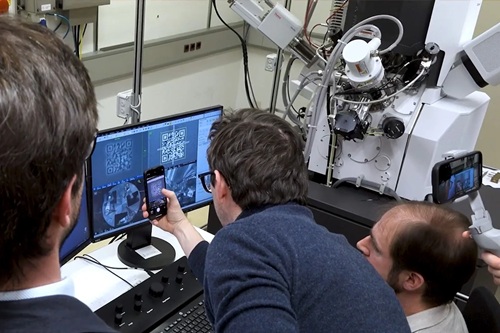
Researchers in Karlsruhe have achieved a remarkable technological breakthrough by creating the world’s smallest QR code, earning official recognition as a Guinness World Record.
The tiny QR code was developed by scientists at the renowned Karlsruhe Institute of Technology using advanced nanotechnology. The code is so small that it is invisible to the naked eye and can only be seen using powerful microscopes.
Despite its microscopic size, the QR code remains fully functional. When scanned with specialized imaging equipment, it directs users to digital information just like any normal-sized QR code.
Officials from Guinness World Records reviewed and verified the measurements before confirming it as the smallest QR code ever created.
Scientists explained that the QR code was produced using high-precision techniques normally used in semiconductor manufacturing. The project demonstrates how data can be stored and accessed even at extremely small scales.
“This shows the incredible possibilities of nanotechnology,” one researcher said. “We can now place digital information onto surfaces smaller than a grain of dust.”
Experts say this innovation could have important applications in electronics, security, and medicine. Tiny QR codes could be used to track microscopic devices, protect products from counterfeiting, or store information in miniature systems.