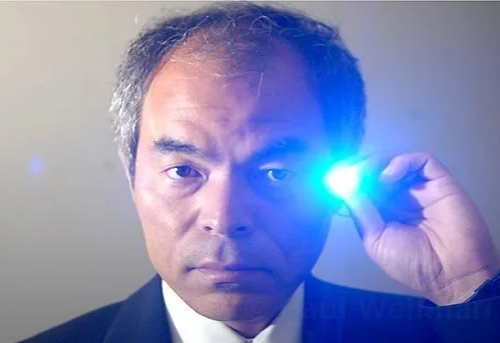
For decades, scientists had mastered red and green LEDs, but the elusive blue light remained out of reach. It took thirty years, countless failed experiments, and the unwavering determination of a single engineer to create a blue LED—and in doing so, revolutionize technology.
Red LEDs emerged in 1962, followed by green LEDs in the 1970s. But blue LEDs posed an extraordinary challenge: producing blue light requires a huge energy jump that most materials simply cannot achieve. Researchers experimented with silicon carbide, zinc selenide, and gallium nitride, yet each attempt proved unstable, impractical, or impossible.
Enter Shuji Nakamura, a Japanese engineer working at a modest firm. While the broader scientific community abandoned gallium nitride, Nakamura persevered, often working alone with minimal support. Colleagues doubted him, and his employer provided little encouragement. Yet he continued, believing in the impossible.
In 1993, Nakamura’s persistence paid off. Using an innovative technique to grow flawless gallium nitride crystals, he created the first practical blue LED. This breakthrough unlocked the ability to produce white LED lighting, full-color displays, and Blu-ray technology, and has since contributed to cutting an estimated 1.4 billion tons of CO₂ emissions annually.
In 2014, Shuji Nakamura was awarded the Nobel Prize in Physics, recognizing the profound impact of his work. His story is a testament to the power of perseverance and the belief that brilliance often emerges not from ease, but from refusing to surrender when the world says it cannot be done.