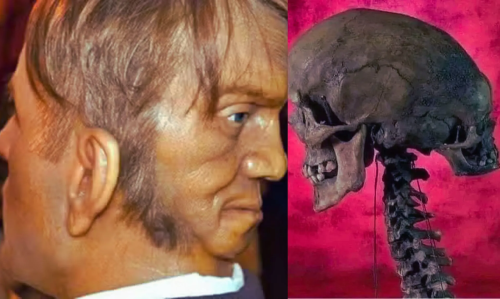
In the quiet nights of Victorian England, when people feared even their own reflections, one man carried a burden far stranger than anyone could imagine—Edward Mordrake, the man said to have been born with two faces.
Mordrake suffered from a rare and mysterious condition described in early medical literature as craniofacial duplication, an extremely uncommon anomaly in which duplicated facial features appear on the head. According to historical accounts, Edward had a second face on the back of his skull—one that, observers claimed, could open its eyes, twitch, and form faint expressions.
Though the second face was not connected to his primary brain, its disturbing motions shocked everyone who saw it. Physicians of the era were left speechless, unable to fully explain the phenomenon with the scientific knowledge available at the time.
His case became one of the most talked-about medical curiosities in history, appearing in journals, newspapers, and later folklore. Even today, more than a century later, Edward Mordrake’s story remains shrouded in mystery—part medical anomaly, part legend, and an enduring reminder of nature’s most unexplainable wonders.
Mordrake’s life continues to fascinate doctors, historians, and researchers, making his case one of the most extraordinary chapters in the study of rare human conditions.