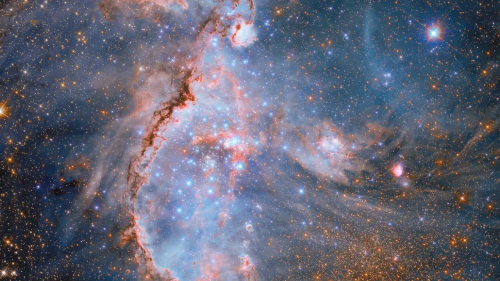
A breathtaking image captured by NASA’s Hubble Space Telescope has reignited global fascination with the wonders of the universe. The photograph reveals a towering cosmic structure known as “Mystic Mountain,” located nearly 7,500 light-years away from Earth within a nebula rich in newly formed stars.
Mystic Mountain is an enormous pillar of gas and dust, rising nearly three light-years high. Its dramatic, rugged form closely resembles a massive mountain peak, a visual similarity that has inspired awe and imagination around the world. Because of its steep, rocky appearance, the structure was given its evocative name by astronomers studying the region.
The image was shared by NASA on the occasion of International Mountain Day, symbolically linking Earth’s natural peaks with the towering formations found in deep space. According to NASA, the Hubble Space Telescope observes the universe from what they describe as the “highest peak” imaginable—space itself—and this image reflects that perspective beautifully.
Mystic Mountain is part of a star-forming region where intense radiation from young stars sculpts clouds of gas and dust into dramatic shapes. Over time, these forces carve pillars and ridges, creating formations that can appear strikingly familiar to the human eye, even though they exist on an unimaginable cosmic scale.
The image serves as a reminder of both the power of modern astronomy and the endless mystery of the universe. While the structure is purely natural in origin, its resemblance to earthly landscapes highlights how the cosmos continues to inspire wonder, belief, and curiosity across cultures. As telescopes like Hubble continue to peer deeper into space, they reveal not only scientific truths but also visuals that connect humanity emotionally to the vast universe beyond our planet.