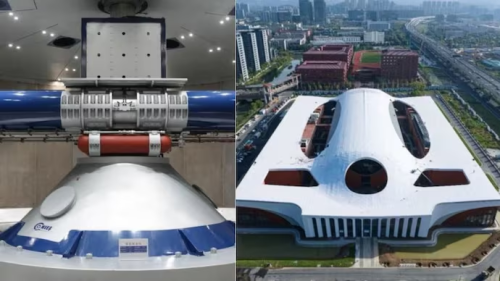
China is preparing to push the boundaries of scientific research with the development of CHIEF1900, a colossal next-generation hypergravity centrifuge designed to recreate catastrophic events such as dam failures, earthquakes, and large-scale structural collapses inside a laboratory. According to a Chinese university involved in the project, the new facility is set to break China’s own world record in hypergravity research.
The CHIEF1900 centrifuge is engineered to spin multi-tonne samples at unprecedented intensities, generating extreme gravitational forces that allow scientists to study how massive structures behave under disaster-level stress. Unlike conventional centrifuges, which are limited to small-scale models, CHIEF1900 will enable testing of much larger and heavier specimens with greater realism and accuracy.
Researchers say the facility will play a crucial role in improving disaster prevention and infrastructure safety. By simulating earthquakes, landslides, and dam breaches under controlled conditions, engineers can better understand failure mechanisms and design stronger, more resilient infrastructure before real-world disasters occur.
The project represents a major leap in hypergravity engineering, a field that combines physics, civil engineering, and materials science. Data generated by CHIEF1900 is expected to influence the design of dams, tunnels, high-rise buildings, and transportation systems, especially in regions prone to seismic activity.
University officials involved in the project emphasized that the centrifuge will also serve as a national research platform, supporting collaboration between academic institutions, government agencies, and industry. The facility is expected to attract global attention from scientists studying extreme environments and structural safety.
Once operational, CHIEF1900 will stand as one of the most powerful centrifuge systems ever built, reinforcing China’s leadership in large-scale experimental engineering. Experts believe the technology could significantly reduce future disaster risks by allowing engineers to test worst-case scenarios before they happen, rather than learning lessons only after tragedy strikes.