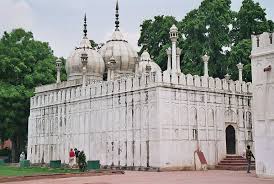
The Moti Masjid, or “Pearl Mosque,” is a distinguished white marble mosque situated within the Red Fort complex in Delhi, India. Constructed between 1659 and 1660 by Mughal Emperor Aurangzeb, it was designed as a private mosque for the emperor and his family.
The mosque is characterized by its three white marble domes and a series of arches, all set within a rectangular courtyard. The simplicity and elegance of its design are notable, with minimal ornamentation compared to other Mughal structures.
The interior features a central prayer hall with a mihrab (prayer niche) and a marble screen, known as a jali, which separates the women’s section from the men’s. The walls are adorned with delicate carvings and inscriptions, reflecting the artistic style of the period.
Emperor Aurangzeb commissioned the Moti Masjid as a private place of worship, reflecting his personal devotion and the growing influence of Islamic orthodoxy during his reign. Unlike the grand Jama Masjid in Delhi, which was built for public congregational prayers, the Moti Masjid served the private needs of the royal family.
The Moti Masjid is part of the Red Fort complex, a UNESCO World Heritage site. Visitors can explore the mosque as part of their tour of the fort, which also includes other significant structures such as the Diwan-i-Aam and Diwan-i-Khas. The fort is open to the public, and guided tours are available to provide deeper insights into its history and architecture.