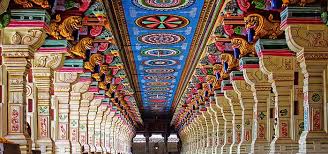
The Ramanathaswamy Temple in Rameswaram, Tamil Nadu, is one of the holiest temples dedicated to Lord Shiva. It holds great religious significance, particularly in the context of the Hindu pilgrimage circuit of Char Dham, as it is considered one of the 12 Jyotirlingas (sacred abodes of Lord Shiva). Here is detailed information about the temple, especially its famous corridor.
- The Ramanathaswamy Temple is believed to have been originally constructed during the 12th century CE by Raja Raja Chola I and later expanded by the Raja of the Sethupathi Dynasty.
- The temple is dedicated to Lord Shiva as Ramanathaswamy and is also connected to the legend of Lord Rama, the hero of the Ramayana. According to the legend, after Rama defeated Ravana and rescued his wife, Sita, he worshipped Lord Shiva at this temple to absolve himself of the sin of killing a Brahmin (Ravana, who was considered a Brahmin by birth).
- The temple is renowned for being part of the Char Dham pilgrimage, which includes other important destinations like Badrinath, Puri, and Dwarka.
- The Ramanathaswamy Temple is one of the largest temples in India, covering an area of 15 acres. It is known for its stunning Dravidian-style architecture, featuring grand gopurams (gateway towers) and intricately carved sculptures.
- The temple has two main sanctums, one dedicated to Ramanathaswamy (Lord Shiva) and the other to Parvati, Lord Shiva’s consort.
- The corridors of the temple are particularly famous, with the most well-known being the corridor with a thousand pillars.
- The corridor, also known as the “Azhagar Kovil”, is an architectural marvel. It stretches for an impressive length of 1,220 meters (4,002 feet), making it one of the longest corridors in any Indian temple.
- Although it is popularly referred to as the “corridor with a thousand pillars”, it actually has 1,212 pillars. These pillars are intricately sculpted and painted, creating an awe-inspiring visual experience for visitors.
- The columns are beautifully adorned with mythological figures, deities, gods, and goddesses, with some depicting scenes from the Ramayana and Mahabharata. The artwork on these pillars is a mix of sculpture and painting, highlighting the skill of the artisans from the 17th century.
- The corridor is designed in such a way that it aligns with the sanctum and leads pilgrims in an orderly fashion towards the shrine of Ramanathaswamy.
- The corridor plays a vital role in the temple’s ritualistic practices. Pilgrims walk through this corridor as part of their journey towards the main sanctum where they offer prayers to Lord Shiva.
- The path through the corridor is considered sacred, and it is believed that walking through it and observing the art on the pillars helps devotees immerse themselves spiritually in the temple experience.
- The pillars are also a visual representation of the connection between earth and heaven, with the deities sculpted along the corridor representing divine forces watching over the journey of the devotee.
- The Ramanathaswamy Temple is also famous for its sacred tanks (holy ponds), the most prominent being the 22 Theerthams (holy water bodies), where devotees bathe before entering the main shrine to purify themselves.
- One of the most sacred water tanks is the Koti Theertham, a large pond located within the temple complex, which is believed to contain the waters of all the sacred rivers in India.
- The spiritual rituals performed at the temple include the Abhishekam (sacred bathing of the idol), Arti, and Pradakshina (circumambulation of the temple).
- The temple’s sanctum has two primary shrines: one for Ramanathaswamy (Lord Shiva) and another for his consort, Parvati. These shrines are very close to each other, reflecting the union of Lord Shiva and Parvati.
- The Shiva lingam in the Ramanathaswamy Temple is considered one of the oldest and most revered in India. It is unique in that it was installed by Lord Rama himself. The temple is believed to house the lingam that was originally crafted by Rama and Sita during their exile.
- The temple sees a large influx of devotees during major Hindu festivals such as Maha Shivaratri, Ramanavami (the birthday of Lord Rama), and Navaratri. Special poojas and rituals are performed to celebrate these occasions.
- The Ramanathaswamy Temple also celebrates the Rama-Sita marriage festival during the Tamil month of Chithirai (April-May), where thousands of pilgrims come to the temple to celebrate the divine union.
- The Ramanathaswamy Temple attracts not only pilgrims but also tourists who come to admire its architecture and participate in the religious atmosphere. The town of Rameswaram is a key destination in Tamil Nadu, known for its proximity to the Pamban Bridge, which connects the island of Rameswaram to the mainland of Tamil Nadu.
- The Rameswaram island itself is famous for its beautiful beaches, the Pamban Beach, and the Ramanathaswamy Temple, making it a perfect spot for both spiritual and leisure travel.
The Ramanathaswamy Temple in Rameswaram, Tamil Nadu, with its iconic 1,220-meter long corridor adorned with 1,212 sculpted and painted pillars, is one of the architectural wonders of India. The temple complex, with its Dravidian architecture, sacred tanks, and spiritual significance, continues to be a vital pilgrimage site for Hindus. The intricate artwork along the corridor not only enhances the temple’s beauty but also serves as a means to connect the devotees with the divine. It remains a shining example of 17th-century craftsmanship and religious devotion.