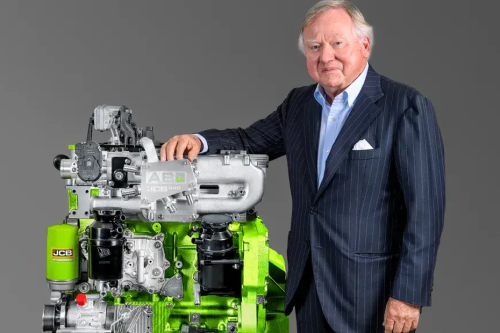
A new era for heavy machinery has been officially launched as JCB’s groundbreaking hydrogen combustion engine receives landmark approval for commercial use. The engine, which produces zero CO₂ emissions at the point of use, has been certified by licensing authorities across Europe, paving the way for a dramatic shift toward cleaner construction and heavy-duty equipment.
JCB, a leader in construction equipment, confirmed that its proprietary hydrogen engine has secured the necessary type approval, allowing it to be legally sold and integrated into machinery across 11 European countries including Great Britain, Germany, France, and the Netherlands.
Diesel Performance, Zero-Carbon Footprint
The key breakthrough is the engine’s ability to deliver identical power and torque to its diesel equivalents, a crucial factor for high-demand, non-road mobile machinery like backhoe loaders and Loadall telescopic handlers.
Technology: JCB’s solution modifies the traditional internal combustion engine to run on hydrogen gas, using spark ignition. This familiar architecture ensures the engine is robust, cost-effective, and easy to maintain compared to more complex fuel cell systems.
Emissions: The engine’s tailpipe emits nothing but steam (water vapor), making it a true zero-carbon solution for the job site.
Investment: The company has invested over £100 million in the four-year development project, which has involved a dedicated team of 150 engineers.
JCB Chairman Anthony Bamford hailed the certification as a “very significant moment,” stating that it “proves that the combustion engine has a promising future in the quest for a net-zero emission world if hydrogen, a zero CO2 fuel, is used.”
On-Site Testing and Global Rollout
With over 130 evaluation engines already produced and currently powering prototype backhoe loaders and telescopic handlers in real-world customer sites, the technology is rapidly progressing towards commercial availability. The new approval streamlines its rollout across key global markets, marking a pivotal moment in the energy transition for industrial sectors.
This development positions hydrogen combustion as a viable, scalable, and powerful solution for industries where battery-electric power is often impractical due to high energy requirements and long operating hours.