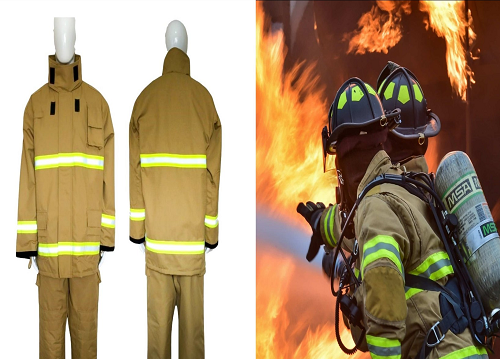
At the second Public Security Tech Expo in Lianyungang, Chinese materials company Safmax unveiled a new range of advanced protective fabrics capable of withstanding extreme temperatures, moisture, and wind — while remaining lightweight and breathable.
Among the innovations showcased was a flame-retardant material that can withstand temperatures up to 1,200°C (2,192°F) without deforming, shrinking, or melting. The company says the fabric could revolutionise firefighting gear, fire blankets, and battery fire isolation systems used in new energy vehicles (NEVs), where rapid and intense fires pose significant safety risks.
“Our new flame-retardant fabric offers the most effective and convenient solution to combat high-intensity fires,” said Jiang Huangsen, Chief Technology Officer at Safmax. “It represents a leap forward in thermal protection technology while maintaining comfort and flexibility.”
Safmax also introduced nano-membrane fabrics that are waterproof, windproof, yet breathable, thanks to a membrane coating thinner than one per cent of human hair. This innovation could benefit industries ranging from public safety and defence to sportswear and outdoor apparel.
While traditional flame-resistant materials often rely on modacrylic fibres, aramid blends like Nomex, or chemical flame retardants such as phytic acid (PA) and ammonium polyphosphate (APP), Safmax’s approach uses nano-scale engineering to deliver enhanced protection without sacrificing comfort.
In recent years, researchers have explored advanced coatings using amino-siloxane and phosphorus-based compounds to improve the durability and performance of flame-retardant textiles. Safmax’s innovation builds on these principles, combining heat resistance, hydrophobicity, and structural strength into a single composite fabric.
Conventional firefighter uniforms rely on multi-layered assemblies combining aramid fibers, moisture barriers, and thermal liners — but Safmax’s single-layer approach could simplify production while maintaining or even improving protection levels.
Though Huangsen did not reveal the precise chemical composition of the new materials, experts at the expo hailed the technology as a potential breakthrough in public safety and industrial protection, with implications for electric mobility, aerospace, and emergency response applications