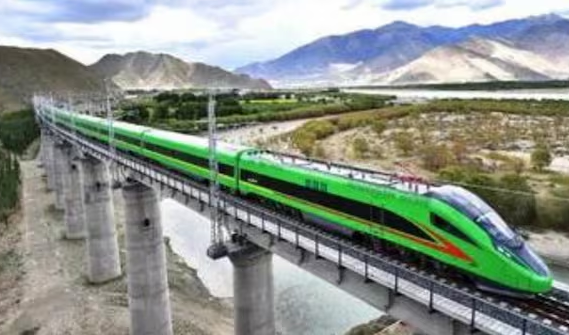
China has officially launched construction on a major new railway line near its border with India, a strategic infrastructure project that is expected to enhance connectivity between its Xinjiang and Tibet autonomous regions. The new railway, a key component of China’s long-term development plan, is estimated to cost approximately $13 billion in initial registered capital.
The ambitious project, named the Xinjiang-Tibet railway, has sparked concerns in India due to its proximity to the Line of Actual Control (LAC). According to reports, a section of the railway is planned to run parallel to the G219 highway, a crucial strategic road that traverses the disputed Aksai Chin region, a territory claimed by India but controlled by China.
While Chinese state media has focused on the railway’s role in boosting economic development and tourism, defense analysts and security experts in India and other countries view the project as having significant military implications. The railway would drastically cut down the time required to move troops and heavy military equipment to the border, strengthening China’s logistical and operational capabilities in the event of a conflict.
The Xinjiang-Tibet railway is part of a broader infrastructure push by China in its western regions, aimed at creating a robust network of roads, rail lines, and airfields. This development comes amid ongoing diplomatic efforts between New Delhi and Beijing to de-escalate tensions and stabilize the border situation. However, the construction of this rail line is likely to add a new layer of complexity to the already strained bilateral relationship, raising fresh security apprehensions in India.