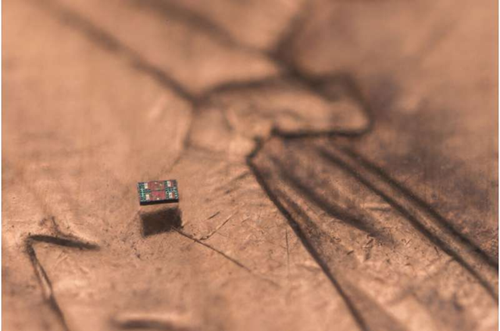
Researchers at the University of Michigan, in collaboration with the University of Pennsylvania, have developed the world’s smallest fully programmable, autonomous robots, marking a major milestone in microrobotics and paving the way for future advances in medicine and microscale manufacturing.
Each of these microrobots measures just about 200 × 300 × 50 micrometers smaller than a grain of salt yet is equipped with a microscopic onboard computer, sensors, and propulsion capabilities that allow it to sense its environment, move independently through liquids, and respond without external control.
Powered by light, the bots can operate for months at a time and are capable of complex programmed behaviors such as navigating temperature gradients and coordinating movements in groups. They are designed to function autonomously without tethers or magnetic fields, representing the first true example of robots at this microscopic scale. One of the most striking aspects of this breakthrough is cost efficiency: each robot can be manufactured for approximately one cent, thanks to scalable fabrication techniques.
Tom’s Hardware
Potential future applications include monitoring the health of individual cells, targeted medical treatments, environmental sensing, and constructing microscopic components that today’s machines cannot access. While current versions rely on light power and are being tested in controlled environments, researchers are already exploring biocompatible upgrades and enhanced functionality for real-world use.
This achievement not only sets a new record in robotics but also opens a new frontier where machines operate at the scale of biology itself, promising innovations that merge technology with the intricate complexity of life and manufacturing at microscopic levels.