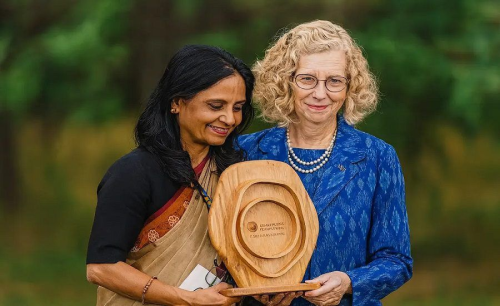
Indian Administrative Service (IAS) officer Supriya Sahu has been awarded the United Nations’ highest environmental honour, marking a historic moment for Indian public administration and environmental leadership. The recognition celebrates her decades-long commitment to restoring ecosystems, protecting biodiversity, and building climate resilience across Tamil Nadu.
Supriya Sahu’s journey is defined by quiet determination and long-term vision. At a time when environmental governance was still evolving in India, she took bold decisions that placed sustainability at the centre of development. As early as the year 2000, she played a key role in implementing a ban on plastic in the fragile Nilgiris ecosystem — a move considered far ahead of its time.
Over the years, her leadership has helped transform landscapes across the state. From large-scale afforestation drives that led to the planting of over 100 million trees, to urban initiatives aimed at cooling cities and improving green cover, her work demonstrates how policy, science, and administration can work together for lasting impact.
Supriya Sahu has also been instrumental in protecting Tamil Nadu’s coastline, restoring wetlands, safeguarding mangroves, and strengthening natural barriers against cyclones and climate-related disasters. Her ecosystem-based approach has not only preserved biodiversity but also protected livelihoods and enhanced disaster resilience for coastal communities.
What sets her apart is consistency. Across changing political priorities and administrative challenges, her clarity of purpose never wavered. She championed sustainable development as a necessity, not a choice, proving that environmental protection and economic growth can move forward together.
The United Nations honour places her among a select group of global environmental leaders and shines a spotlight on India’s capacity to drive climate solutions through strong public institutions. It also sends a powerful message about the role of civil servants in shaping the planet’s future.