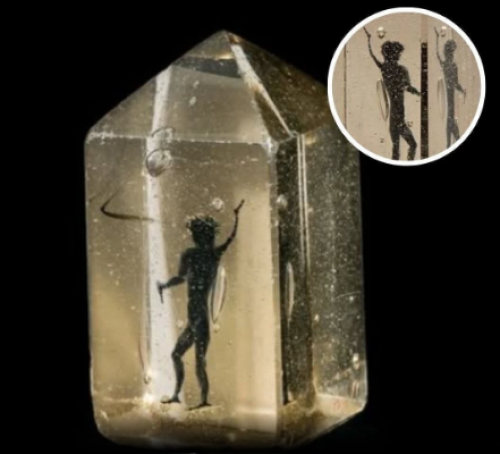
Nestled among the priceless artifacts of the Imperial Treasury of Vienna is one of the most unusual relics of the 17th century: a sealed glass vessel reputed to contain a demon. According to historical records, the vessel originated from a formal exorcism in Germany, during which clergy claimed to have expelled a malevolent spirit and trapped it in the container as a tangible proof of spiritual authority.
Exorcisms in the early 1600s were elaborate and highly ritualized, reflecting widespread belief in demonic possession and supernatural influence. Clergy documented these rituals carefully, and objects associated with them often served as both religious evidence and social warning. The Vienna vessel, simple and tightly sealed, was preserved as an example of spiritual triumph and cautionary display.
Historians note that the “demon-in-glass” embodies more than superstition. It offers a window into the mindset of early modern Europe, where fear, faith, and ritual intertwined to shape law, medicine, and daily life. Items like this were both didactic and symbolic, asserting clerical authority while reinforcing societal norms and moral expectations.
Modern science, of course, cannot detect any supernatural presence. The vessel contains only glass and air, yet its significance lies in its story and the belief systems it represents. Scholars emphasize that such artifacts help contextualize how early Europeans understood illness, misfortune, and the invisible forces they believed governed the world around them.
Today, the “demon-in-glass” remains a striking relic—less as evidence of the supernatural than as a vivid testament to the cultural imagination of the 17th century. Visitors to the Imperial Treasury can view it not merely as a curiosity, but as a symbol of the complex interplay between fear, faith, and authority that defined an era.