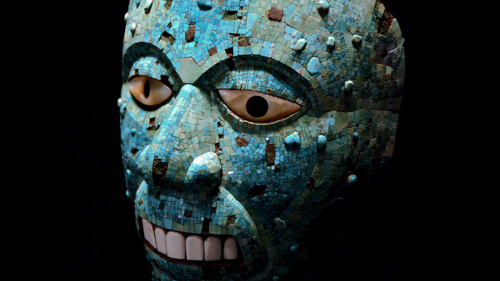
Behind protective glass in the British Museum sits a striking 600-year-old Aztec mask, dazzling in turquoise mosaic, mother of pearl, and conch shell. Yet despite its beauty, historians believe this artifact’s journey from Mesoamerica to Europe was far from peaceful.
Crafted from carved wood and intricately inlaid with precious materials, the mask’s interior is stained with cinnabar, a toxic red pigment commonly associated with ritual use in Aztec ceremonial practices. Such materials suggest the object held deep spiritual significance rather than serving a decorative purpose.
Many scholars believe the mask was taken during the Spanish conquest of the Aztec Empire, possibly seized by Hernán Cortés in the early 16th century. If so, it would have been removed amid violence, cultural destruction, and the collapse of one of the Americas’ most powerful civilizations.
Traditionally, the mask has been associated with Xiuhtecuhtli, the Aztec god of fire, time, and renewal. Fire played a central role in Aztec cosmology, symbolizing rebirth and the continuation of the universe. However, this identification is not universally accepted. Some researchers argue the mask may instead represent Nanahuatzin, the deity who sacrificed himself to become the sun and set the cosmos in motion.
What continues to unsettle scholars is the lack of certainty surrounding the mask’s true identity and ritual function. It remains unclear whether it was worn, displayed, or used in sacred fire ceremonies. This ambiguity leaves the artifact suspended between meanings—visually magnificent, historically scarred by conquest, and still not fully understood.