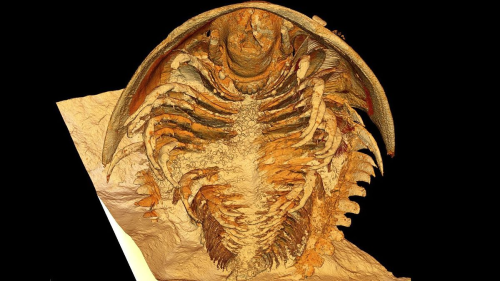
Scientists and fossil enthusiasts are once again turning their attention to trilobite fossils—ancient marine creatures that lived more than 350 million years ago—after renewed studies highlighted their extraordinary place in Earth’s deep history. These remarkable fossils date back to a time long before humans existed, before flowering plants appeared, and even before the continents reached their modern positions.
Trilobites thrived in ancient oceans for nearly 300 million years, making them one of the most successful early life forms on the planet. With their distinctive segmented bodies, compound eyes, and spiny exoskeletons, trilobites roamed prehistoric seas during the Paleozoic Era. Their fossils are now found embedded in sedimentary rock across the world, with some of the most well-preserved specimens discovered in regions such as Morocco.
Paleontologists consider trilobites vital to understanding early evolution, as they were among the first animals to develop complex vision and defensive adaptations. Some species could curl into a ball for protection, while others evolved long spines to deter predators. These features reveal a surprisingly advanced level of biological innovation for such ancient organisms.
The extinction of trilobites occurred around 252 million years ago during the Permian mass extinction, one of the most catastrophic events in Earth’s history. Despite their disappearance, trilobites continue to offer invaluable clues about ancient marine ecosystems, climate shifts, and the early development of life on Earth.
Today, trilobite fossils are studied in museums, universities, and research labs worldwide, while also captivating the public imagination. Often described as “alien-looking,” these fossils remind humanity of a time when life on Earth was vastly different, yet already incredibly complex.
The study of trilobites stands as a powerful reminder that Earth’s history stretches far beyond human memory, revealing a planet shaped by countless life forms over hundreds of millions of years—each leaving behind traces that continue to deepen our understanding of the ancient world.