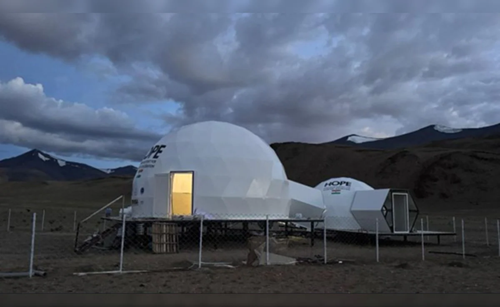
The Indian Space Research Organisation (ISRO) has inaugurated India’s first-ever planetary analog mission facility, the Himalayan Outpost for Planetary Exploration (HOPE), in the remote Tso Kar Valley of Ladakh. The high-altitude station is designed to simulate the extreme environmental conditions of the Moon and Mars, providing a vital ground-based testbed for future Indian interplanetary missions.
Situated at an elevation of over 4,500 metres in the arid, high-UV, low-pressure desert of Tso Kar, the HOPE facility replicates many of the harsh conditions expected on lunar and Martian surfaces. This environment enables scientists and engineers to study human physiological and psychological responses, test life-support systems, habitat designs, and operational protocols, and refine technologies in preparation for future crewed missions beyond Earth.
Inaugurated on 31 July 2025 under the leadership of Dr. V. Narayanan, Secretary of the Department of Space and Chairman of ISRO, HOPE includes a specially constructed habitat module for crew living and a connected utility module for support systems—allowing researchers to investigate workflows, environmental adaptation, and surface operations similar to those expected on lunar or Martian missions.
A 10-day analog mission conducted at HOPE from 1–10 August 2025 involved experiments from national institutions and focused on assessing genetic, physiological and psychological responses of crew members in isolation, as well as testing spaceflight technologies and sample-handling methods. The data collected will help shape protocols and infrastructure for India’s upcoming human spaceflight and interplanetary exploration plans.
HOPE marks a significant milestone in India’s space ambitions, bridging Earth-based research with future goals such as the Gaganyaan human spaceflight programme, a planned Indian Space Station by 2035, and crewed missions to the Moon and Mars by 2040.