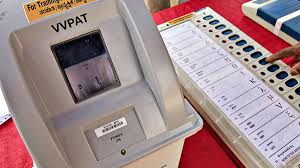
The idea of using Electronic Voting Machines (EVMs) was conceived by the Election Commission of India (ECI) in 1977.
The Electronics Corporation of India Ltd. (ECIL) developed the prototype, which was demonstrated in 1980.
EVMs were designed to replace paper ballots and address issues like electoral fraud, human error, and rigging.
EVMs were first used experimentally in the 1982 Kerala assembly by-elections to test the technology in a real electoral scenario.
From 1998 to 2001, EVMs were gradually introduced in state assembly elections and eventually in general elections.
By 2014, EVMs were used in all general and state assembly elections across India, marking their widespread adoption.
EVMs have helped reduce fraud, improved efficiency, and eliminated paper ballots.
In 2013, VVPAT was introduced, allowing voters to verify their vote on a paper slip after casting their vote electronically.
This system enhanced transparency and trust in the electoral process.
EVMs are equipped with over 275 safety protocols, making them tamper-proof and secure.
Designed to be portable and easy to use, they facilitate faster vote counting and enhanced election security.
Bharat Electronics Limited (BEL) in Bengaluru and ECIL in Hyderabad are the main manufacturers of EVMs in India.
To date, over 315 crore votes (3.15 billion) have been cast using EVMs, making them a central part of India’s election infrastructure.
EVMs have played a crucial role in modernizing India’s election system, reducing fraud, and improving efficiency.
VVPAT and multiple safety measures further secure the process and ensure transparency.
Over 315 crore votes have been cast using EVMs, cementing their significance in the democratic process.