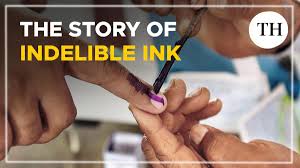
Indelible ink was introduced in the 1962 Lok Sabha elections to address the issue of multiple voting by a single individual.
The ink is formulated to be semi-permanent, staining the skin in a way that cannot be easily removed, ensuring that a voter cannot cast another vote in the same election.
The responsibility for manufacturing indelible ink was assigned to Mysore Paints and Varnish Limited (MPVL), a government-owned company based in Mysore (now Mysuru), Karnataka.
Since its introduction, MPVL has remained the sole supplier of indelible ink for all elections conducted in India.
The production process adheres to strict quality standards to ensure the ink’s effectiveness and durability.
Indelible ink played a crucial role in curbing bogus voting and voter impersonation. Once marked, a voter’s finger provided a visible sign that they had already voted.
The ink became a symbol of trust and integrity in India’s electoral process, reinforcing public confidence in the fairness of elections.
Indelible ink is used in all types of elections in India, including general elections, state elections, by-elections, and local body elections.
The use of ink simplifies the verification process for election officials, reducing the chances of electoral malpractice.
Over the years, the formulation of the ink has been refined to improve its longevity and visibility.
The marking process has also been standardized to ensure uniform application across different regions and polling stations.
The ink is also used in local governance elections to maintain electoral integrity at the grassroots level.
Occasionally, indelible ink has been used in non-electoral scenarios, such as marking individuals during health campaigns or public distribution system initiatives, to prevent misuse of resources.
Indelible ink produced by Mysore Paints has been used in elections in other countries, such as Afghanistan, South Africa, and Indonesia, demonstrating its effectiveness and reliability.
India’s use of indelible ink has served as a model for other democracies looking to prevent multiple voting and enhance the credibility of their electoral processes.
The introduction of indelible ink in the 1962 Lok Sabha elections marked a significant advancement in India’s electoral system, effectively preventing multiple voting and voter impersonation. Mysore Paints and Varnish Limited, based in Mysuru, has been the sole manufacturer of this ink, ensuring its consistent quality and availability for all Indian elections. The indelible ink continues to be a vital component of the Election Commission of India’s strategy to conduct free and fair elections, symbolizing the integrity of the democratic process in India and influencing electoral practices globally.