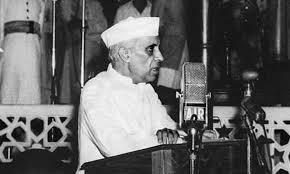
Prime Minister of India (15 August 1947 – 27 May 1964) 17 years
Jawaharlal Nehru was India’s first Prime Minister and one of the central figures in the Indian independence movement.
He played a pivotal role in shaping India’s democratic institutions and foreign policy.
Nehru’s leadership helped establish the foundation for India’s planned economy and industrialization, and he was instrumental in the creation of public sector enterprises.
Under his leadership, India became a member of the Non-Aligned Movement and maintained a policy of non-alignment during the Cold War.
Prime Minister of India (1964–1966)
Shastri passed away in Tashkent, Uzbekistan, after signing the Tashkent Agreement with Pakistan following the 1965 India-Pakistan war.
Lal Bahadur Shastri is remembered for his role in strengthening India’s defense and for the 1965 India-Pakistan war where he led India to victory.
His famous slogan “Jai Jawan Jai Kisan” (“Hail the soldier, Hail the farmer”) reflected his focus on both national security and agricultural growth.
Shastri’s sudden death raised suspicions and remains a subject of controversy.
Indira Gandhi (1917–1984) Prime Minister of India (1966–1977, 1980–1984)
Indira Gandhi was assassinated on 31 October 1984 by her own Sikh bodyguards, in the aftermath of Operation Blue Star. She became the first Prime Minister of India to be assassinated while in office.
She was the first and only woman to serve as Prime Minister of India.
Indira Gandhi is known for her strong leadership during critical times, including the India-Pakistan war (1971) and the Bangladesh Liberation War.
Her leadership, however, was also marked by her declaration of the Emergency in 1975, which curtailed civil liberties and led to political turmoil.