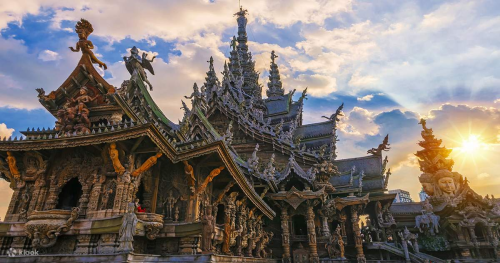
In the coastal city of Pattaya, Thailand, a breathtaking architectural marvel has quietly reached a historic milestone. The Sanctuary of Truth — the world’s largest entirely wooden structure, known in some Indian circles as the “Krishna Temple” for its intricate carvings of Krishna and other Hindu deities — is now considered substantially complete after 44 years of continuous craftsmanship.
Rising like a mythical palace by the Gulf of Thailand, the Sanctuary of Truth (Thai: ปราสาทสัจธรรม) is an extraordinary blend of temple and castle, built entirely from traditional Thai hardwoods such as Ta-khian, Teak, and Mai Daeng. Not a single metal nail or bolt has been used. Instead, ancient Asian woodworking techniques — tongue-and-groove joinery, wedges, wooden dowels, and interlocking joints — hold this monumental structure together.
Inspired by the Ayutthaya-era architecture, the sanctuary embodies the spiritual heritage of Hinduism, Buddhism, Brahmanical philosophy, and ancient Chinese thought. Every inch of its surface is hand-carved with scenes representing cosmic order, the cycle of life, and divine stories — including depictions of Lord Krishna, celestial beings, and philosophical allegories.
The vision began in 1981, conceived by Thai businessman and philanthropist Lek Viriyaphan, who also commissioned Bangkok’s iconic Erawan Shrine. His dream was to create a universal sanctuary — a place where world leaders, thinkers, and seekers could reflect on peace, spirituality, and the human quest for truth.
Spread across 13 hectares, the structure stands 105 meters tall at its central spire and houses 2,115 square meters of intricately carved interior space. For decades, teams of skilled artisans sculpted every panel by hand, turning massive timbers into delicate stories of faith and philosophy.
By September 13, 2025, new photographs and videos confirm that the structure has reached its most complete form yet, with its architectural framework and artistic detailing largely finished. While some sources suggest that ongoing restoration and refinements may continue until 2050, experts agree that the monument is now structurally complete and fully open to visitors.
Given the natural durability of the hardwoods used — some capable of lasting 600 years or more — the sanctuary is expected to stand for centuries, provided its regular conservation continues.