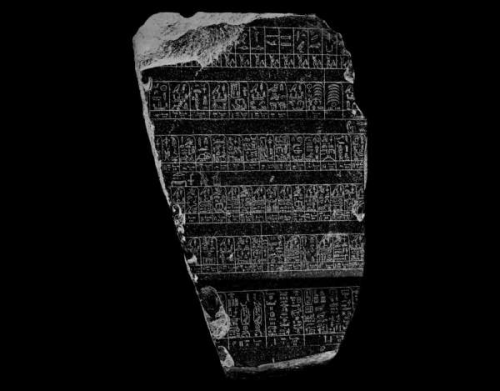
The Palermo Stone stands as one of the most mysterious and important relics of ancient Egypt, offering a rare glimpse into a past that stretches far beyond conventional historical timelines. Carved from black basalt more than 4,000 years ago, this fragmentary artifact is believed to be part of a much larger royal annal that once recorded the reigns of Egypt’s earliest rulers in remarkable detail.
What makes the Palermo Stone extraordinary is its content. Inscribed in ancient hieroglyphs, the stone lists kings and significant events year by year, including religious ceremonies, state activities, and even the annual height of the Nile floods — information crucial to understanding Egypt’s agricultural cycles and economic stability. Such precise record-keeping highlights the administrative sophistication of early Egyptian civilization.
Most strikingly, the Palermo Stone does not begin with the well-known First Dynasty. Instead, it records rulers who existed before Egypt’s dynastic age, extending the country’s remembered past back an estimated 9,000 to 11,000 years. These pre-dynastic kings are otherwise absent from most historical sources, making the stone a unique and controversial reference for scholars studying the origins of Egyptian civilization.
Today, only fragments of the original royal inscription survive. The largest piece, known as the Palermo Stone, is housed at the Regional Archaeological Museum Antonio Salinas in Palermo, Italy, while other fragments are preserved in Cairo and London. The loss of the majority of the original slab means that large portions of this ancient historical record are missing forever, leaving historians and archaeologists to piece together its meaning from incomplete evidence.