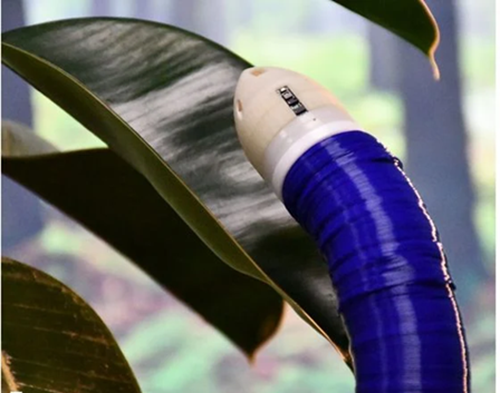
A team of researchers at the Fondazione Istituto Italiano di Tecnologia (Italian Institute of Technology), collaborating with scientists from the University of Montpellier (France), has developed a novel vine‑like robot known as FiloBot that grows outward by 3D‑printing its own body, in a breakthrough blending robotics with biological inspiration. The research, published in Science Robotics, demonstrates how additive manufacturing can be integrated directly into robotic motion enabling the machine to extend itself without traditional joints, motors or rigid actuators.
Unlike conventional robots that rely on fixed links or wheels, FiloBot’s soft, snake‑like design continuously extends from its base as its head extrudes 3D‑printed material, building body segments in real time as it moves forward. This process mimics the growth of climbing plants like vines and allows the robot to adapt its shape and structure to navigate complex environments from narrow corridors to cluttered industrial sites with minimal mechanical complexity.
FiloBot’s growth is not random. Equipped with sensors, the robot can respond to external cues such as gravity and light, choosing its direction of extension much like a plant seeking light or growing upward against gravity. The robot’s head contains a small 3D printer that coils thermoplastic filament into the robot’s body as it advances, while a base station holds the filament spool, power supply and control system.
This bio‑inspired strategy offers several advantages over traditional robotic locomotion:
Reduced mechanical complexity, since the robot doesn’t need conventional joints or actuators.
Adaptive navigation, enabling entry into confined or uneven spaces where rigid robots struggle.
Self‑generated structure, where the robot builds its body only where it’s needed.
Researchers suggest that FiloBot’s unique abilities could prove valuable in inspection, exploration, disaster response, and environmental monitoring tasks where maneuverability and adaptability are crucial and traditional robots may be limited. For example, robots capable of growing into unstable ruins or crossing gaps could enhance search‑and‑rescue efforts after earthquakes or other catastrophes.
FiloBot’s development reflects a wider trend in robotics toward bio‑inspired design, where mechanisms found in nature inform innovative engineering solutions that are more adaptable, resilient and efficient. By combining soft materials, distributed sensing, and real‑time 3D printing, FiloBot represents a promising step toward robots that can autonomously reshape themselves to meet real‑world challenges.