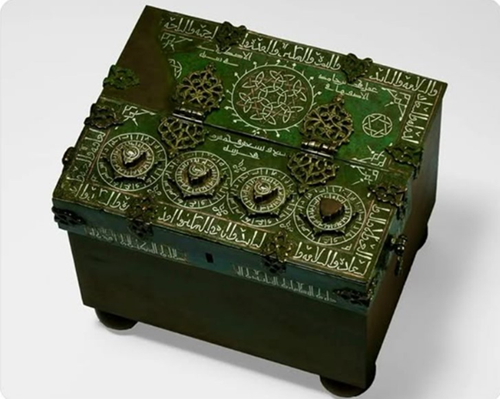
A remarkable mechanical artifact from around 1200 AD in Iran is drawing renewed attention from historians and technology enthusiasts alike. Known as the Seljuk lockbox, this exquisitely crafted device demonstrates that high-security engineering long predates modern safes and digital cryptography.
Crafted by hand during the Seljuk period — a time of flourishing science, art, and craftsmanship in the medieval Islamic world — the lockbox features a complex rotating dial mechanism that experts estimate allows for more than 4.2 billion possible combinations. The box’s four rotating double dials, each capable of being set to 16 positions, were not merely decorative; they formed a precise and advanced locking system designed to protect valuables centuries before the development of modern mechanical combination locks.
Made of cast and hammered brass inlaid with silver and copper, the lockbox bears the signature of its maker, Muhammad ibn Hamid al-Asturlabi al-Isfahani, an astrolabe maker from Isfahan. His expertise in geometry and mechanics is evident in both the elegant design and technical sophistication of the device.
While many medieval locks relied on simple keys, the Seljuk lockbox employed a permutation-based security system — a concept that resembles the logic behind today’s combination safes. The sheer number of possible dial sequences would have made unauthorized access extremely difficult without knowing the correct code. Examples of similar combination locks appear in contemporaneous sources, including the writings of the famed engineer Al-Jazari, who documented related mechanisms in his Book of Knowledge of Ingenious Mechanical Devices in the early 13th century.
Today, fragments of Seljuk lockboxes are preserved in museum collections such as The David Collection in Copenhagen and other institutions, where they continue to fascinate researchers and visitors alike.
Experts say the lockbox is more than a beautiful artifact: it is evidence of a sophisticated understanding of systems, probability, and mechanical logic centuries before the modern age. The craftsmanship reflects a blend of mathematics, engineering, and artistic expression that remains impressive even eight centuries after its creation. As museum audiences and historians revisit this extraordinary device, the Seljuk lockbox stands as a testament to the advanced technological thinking of medieval Islamic engineers — a precursor to the secure mechanisms we rely on in the 21st century.