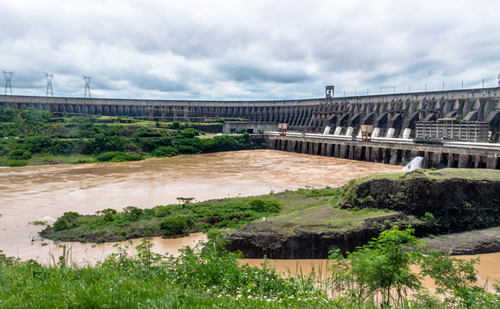
One of humanity’s most ambitious engineering projects, the Three Gorges Dam on the Yangtze River, has done more than just generate clean energy — it has measurably influenced the rotation of the Earth itself. Scientists at NASA’s Goddard Space Flight Center confirm that the colossal dam’s massive water reservoir has altered the planet’s mass distribution just enough to lengthen the duration of a single day by about 0.06 microseconds.
Completed in 2012, the Three Gorges Dam is the largest hydroelectric power station in the world, spanning over 2,300 metres in length and rising 185 metres above sea level. Its reservoir holds a staggering 40 billion cubic metres (about 10 trillion gallons) of water — a volume so vast that raising this mass above the Earth’s axis slightly changed the distribution of the planet’s total mass.
According to physicists, this shift affects the Earth’s moment of inertia, a key concept in rotational dynamics: when more mass is located farther from the rotational axis, the object spins more slowly to conserve angular momentum. In the case of the Three Gorges Dam, this results in an imperceptible but measurable increase in day length — roughly 0.06 microseconds (that’s 0.00000006 seconds).
The effect is incredibly small — far too tiny to influence daily life or human activities. For context, even major earthquakes, like the 2004 Indian Ocean quake, have changed Earth’s rotation by a few microseconds. The Three Gorges Dam’s contribution, though smaller, still offers a clear demonstration of how massive human constructions can interact with planetary systems. Scientists also note a slight shift in Earth’s axis position — by about 2 centimetres — due to the reservoir’s mass redistribution, though this too remains well within natural variability.
Beyond its geophysical effects, the Three Gorges Dam remains a cornerstone of China’s renewable energy strategy, with a generation capacity of about 22,500 MW — one of the largest in the world. Its influence on Earth’s rotation underscores both the scale of human engineering and the complex interplay between human activity and natural systems.
While the day’s lengthening is too minor to be noticed without precise instrumentation, the discovery serves as a powerful reminder: even our most monumental constructions can leave subtle marks on the planet itself.