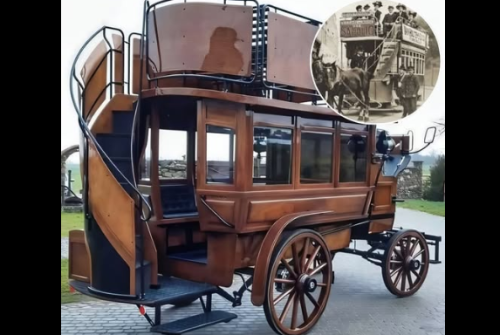
Long before engines, fuel, and electric motors transformed urban life, cities quite literally moved on horsepower. In the late 19th century, horse-drawn buses formed the backbone of public transportation, offering city dwellers a reliable and surprisingly sophisticated way to travel across town. Among the most iconic of these vehicles was the double-decker horse-drawn bus of the 1890s.
Recently restored examples of these historic buses reveal just how advanced public transport was even before the age of machines. Designed for both efficiency and comfort, the buses featured an enclosed lower cabin to protect passengers from rain and cold, while an open-air upper deck offered fresh air and panoramic city views. Access to the top deck was provided by a narrow spiral staircase at the rear—a design element that would later influence modern double-decker buses.
These horse-drawn buses operated on fixed routes with scheduled stops, remarkably similar to today’s mass transit systems. Cities such as London, Paris, and New York relied heavily on them to move workers, shoppers, and visitors through crowded streets at a time when urban populations were rapidly growing. Each bus was typically pulled by two or more horses, carefully managed and rotated to prevent exhaustion.
Despite their slower speeds, the buses were considered stylish and dependable. Conductors collected fares, drivers navigated bustling streets, and stables served as the “depots” of the era, housing and caring for the horses that powered the system.
Historians note that these early transport networks laid the foundation for modern public transit. Concepts like route planning, timetables, fare systems, and multi-level seating all originated during the horse-drawn era. When motorized buses eventually replaced horses in the early 20th century, they inherited both the structure and philosophy of these pioneering systems.