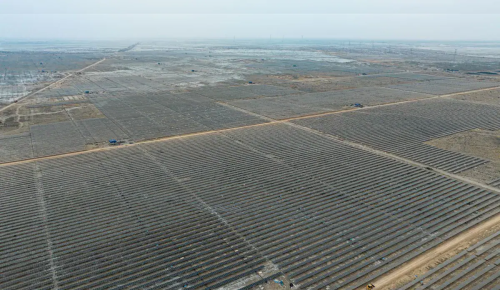
In the vast, barren salt deserts near the Indo-Pak border, India is rapidly constructing a global energy marvel. The Khavda Renewable Energy Park, a 30-gigawatt (GW) hybrid project spanning a staggering 72,600 hectares, has achieved major operational milestones as of December 2025, firmly establishing itself as the world’s largest renewable energy installation.
The park, situated near Vighakot village in Kutch, is roughly five times the size of Paris. Once fully completed by 2028, it will generate approximately 81 billion units of clean electricity annually—enough to power 16 million homes or entire nations like Switzerland or Belgium.
The project is being developed through a massive collaborative effort involving both public and private sector giants.
Adani Green Energy Limited (AGEL): As the lead developer with the largest land allocation (19,000 hectares), AGEL has been operationalizing capacity at a record pace. Following its initial 1 GW milestone in early 2024, the company has scaled up significantly, surpassing 5.6 GW of operational capacity at the site by mid-2025.
NTPC Green Energy: The state-owned major has been equally aggressive. On December 17, 2025, NTPC declared an additional 243.66 MW of its Khavda-I solar project commercially operational, bringing its total footprint in the park to new heights.
Infrastructure Support: Other key players including GIPCL, GSECL, and Sarjan Realities are actively constructing solar and wind blocks, supported by an ₹18,000-crore transmission network managed by the Power Grid Corporation of India.
Beyond electricity, the park is a strategic asset. Located in a high-security zone near the international border, the project has turned “unhabitable” wasteland into a hub of economic activity. It has already created over 15,000 green jobs and is expected to generate 100,000 employment opportunities at peak operations.
In a recent visit to the site, Gujarat Chief Minister Bhupendra Patel noted that the park is the “blueprint for a Viksit Bharat” (Developed India), proving that even the most challenging terrains can be harnessed for a green future.