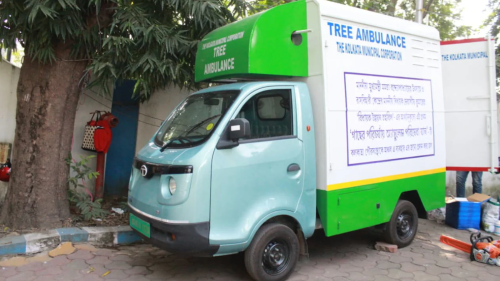
When a city sends an ambulance not for people, but for trees, it sends a powerful message about priorities, responsibility, and the future of urban living. Kolkata has taken a pioneering step by launching a Tree Ambulance service, a first of its kind in eastern India, aimed at providing emergency care to trees in distress.
The initiative responds to SOS calls related to tilted, storm-damaged, uprooted, or weakened trees that pose risks to public safety and urban infrastructure. Instead of cutting such trees as a default solution, trained teams now assess each case to determine whether the tree can be saved through timely intervention.
The Tree Ambulance is equipped to carry out stabilisation, pruning, structural support, treatment of damaged roots and trunks, and even safe relocation when required. The objective is clear: preserve mature trees and prevent irreversible loss before it is too late.
This move comes at a critical time for Kolkata. Environmental surveys indicate that the city already has one of the lowest green covers among major Indian metropolitan areas. Alarmingly, nearly 6 percent of trees in surveyed zones were found to be unbalanced or vulnerable, especially during storms and heavy monsoon winds. Such conditions often lead to sudden tree falls, causing injuries, fatalities, and damage to property.
Traditionally, urban authorities across India have responded after disasters—removing fallen trees once damage is done. Kolkata’s Tree Ambulance marks a strategic shift from reaction to prevention, addressing risks before storms and structural failures occur. Environmental experts say this proactive approach could significantly reduce both ecological loss and public safety hazards.
Beyond safety, the initiative reflects a broader understanding of trees as living assets rather than obstacles to urban development. Mature trees play a crucial role in cooling cities, improving air quality, supporting biodiversity, and mitigating the impacts of climate change. Losing them not only worsens heat and pollution but also erodes the city’s natural resilience.
Civic officials believe the program can become a model for other Indian cities struggling to balance rapid urbanization with environmental preservation. As climate-related extreme weather events become more frequent, such preventive systems may soon be essential rather than optional.