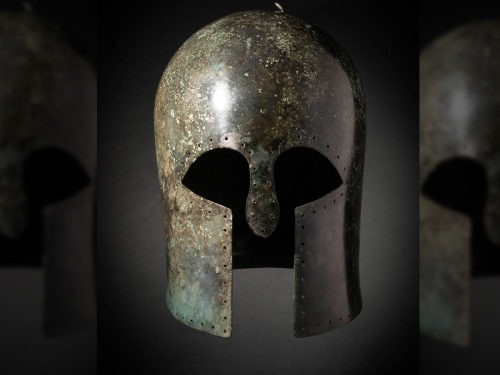
Ancient Greek helmets were among the most important pieces of military equipment, carefully designed to protect warriors in combat while also reflecting their identity, rank, and social standing. In a culture where honor and appearance carried deep significance, a helmet was not only a shield for the head but also a symbol of pride and belonging.
One of the earliest and most recognizable helmet types was the Corinthian helmet. Forged from bronze, it covered the entire head, leaving only narrow slits for the eyes and a small opening for the mouth. This design offered exceptional protection against enemy weapons, making it ideal for close combat. However, the same features that made it so secure also restricted hearing and peripheral vision, forcing soldiers to rely heavily on formation discipline and commands during battle.
As methods of warfare developed and mobility became more important, helmet designs adapted to meet new demands. The Chalcidian helmet introduced wider openings around the ears and eyes, improving awareness while still safeguarding the skull. The Attic helmet, often associated with officers and ceremonial use, left much of the face uncovered, allowing for clearer communication and easier movement on the battlefield. These evolving designs reflect a growing understanding of the balance between defense and functionality.
Decoration played a significant role in ancient Greek helmets. Many featured striking horsehair crests, sometimes dyed in bold colors or arranged to increase the wearer’s apparent height. These crests made soldiers appear more imposing and were often used to signal rank, unit affiliation, or elite status. Beyond crests, helmets were engraved with geometric patterns, mythological imagery, or symbols representing individual city-states, blending artistic expression with military purpose.