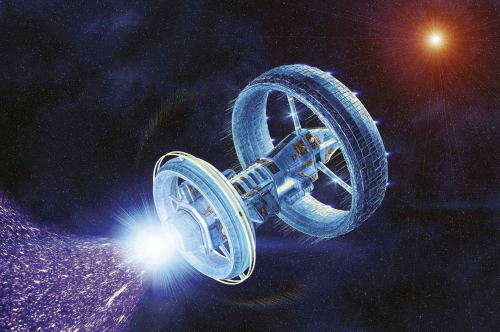
Scientists have proposed a revised warp-drive model that could dramatically reshape how humanity thinks about interstellar travel. Building on the famous Alcubierre warp-drive concept, the new theory removes one of its most controversial and seemingly impossible requirements—the need for exotic negative energy.
The original Alcubierre model suggested that faster-than-light travel could be achieved by warping spacetime itself, contracting space in front of a spacecraft and expanding it behind. However, this idea depended on regions of space containing negative energy density, a form of matter that has never been observed in a usable or stable state. This limitation kept warp drives firmly in the realm of science fiction.
The newly proposed model introduces a breakthrough: it demonstrates that a warp-like spacetime bubble can exist using only normal, positive energy, fully consistent with the known energy conditions of Einstein’s general relativity. This means the model does not rely on unphysical materials or violations of established physics.
In this updated framework, the spacecraft itself still does not move faster than light through space. Instead, spacetime around it is carefully shaped, allowing the vessel to be carried within a controlled “warp bubble.” The crucial difference is that this geometry operates at sub-light (subluminal) speeds, ensuring that no physical laws are broken.
Because the warp bubble is limited to speeds below the speed of light, the concept is often referred to as a subluminal warp drive. While it would not allow instant travel between stars, it could still enable far more efficient and faster-than-conventional space travel compared to current propulsion technologies.
Researchers emphasize that this model remains theoretical and faces enormous engineering challenges before it could ever be tested or built. Nevertheless, by removing the requirement for negative energy, the idea moves warp-drive physics one step closer to scientific plausibility.