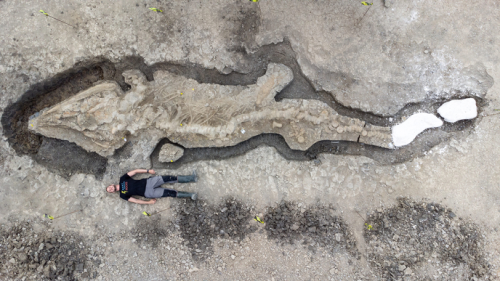
Around 180 million years ago, during the Jurassic period, Earth’s oceans were ruled by powerful marine reptiles known as ichthyosaurs—fast, streamlined hunters perfectly adapted to life in open water. A remarkable new discovery in England has brought one of these ancient giants back into the spotlight, offering rare insight into prehistoric marine ecosystems.
In 2021, researchers uncovered the fossil of a massive ichthyosaur, often described as a “sea dragon,” at Rutland Water in eastern England. Measuring approximately 10 meters (33 feet) in length, the creature ranks among the largest ichthyosaurs ever discovered in the United Kingdom. Its enormous skull suggests it was built to hunt large prey, including fish and squid, placing it firmly at the top of the Jurassic food chain.
What makes this discovery especially significant is the exceptional completeness of the fossil. Large portions of the skull, spine, ribs, and other skeletal elements have been preserved, allowing scientists to study the anatomy in unprecedented detail. Such well-preserved specimens are rare and provide valuable clues about how ichthyosaurs grew, moved, and hunted in ancient seas.
Detailed analysis has helped researchers refine their understanding of ichthyosaur evolution, including how these reptiles adapted to different ecological roles over millions of years. The Rutland sea dragon reinforces the idea that ichthyosaurs were not just common marine animals, but apex predators that played a crucial role in maintaining balance within Jurassic ocean ecosystems.