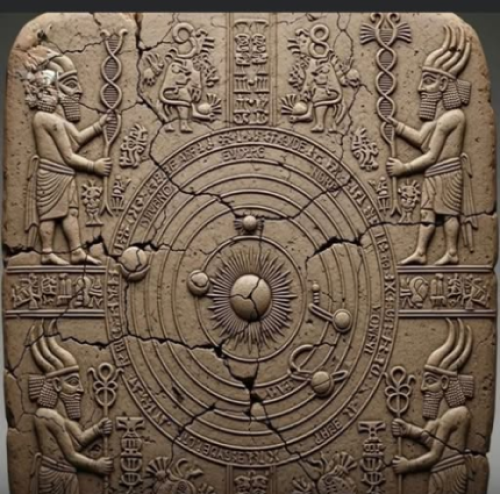
Long before telescopes and satellites, the Sumerians, often called the world’s first civilization, were quietly charting the skies. Using simple instruments and meticulous record-keeping, they tracked celestial events like eclipses, planetary movements, and lunar cycles. These observations formed the foundation for early calendars, timekeeping systems, and agricultural planning, linking their understanding of the heavens directly to practical life.
Ancient clay tablets from Mesopotamia show symbolic depictions of gods alongside celestial bodies, revealing how astronomy and spirituality were deeply intertwined. The Sumerians believed that the movements of planets and stars were governed by divine forces, aligning temples and rituals with celestial patterns. Their myths and writings reflect a worldview where astronomy, theology, and philosophy were inseparable.
While some modern interpretations claim that the Sumerians had mapped the entire solar system or understood DNA-like structures, mainstream scholarship clarifies that these are misinterpretations. The symbols largely represent religious and mythological concepts, not advanced science or extraterrestrial knowledge.
Nevertheless, the Sumerians’ careful observation of the sky laid the groundwork for future civilizations, influencing Babylonian, Greek, and Egyptian astronomy, and reminding us that human curiosity about the cosmos has deep roots stretching back more than 4,000 years.