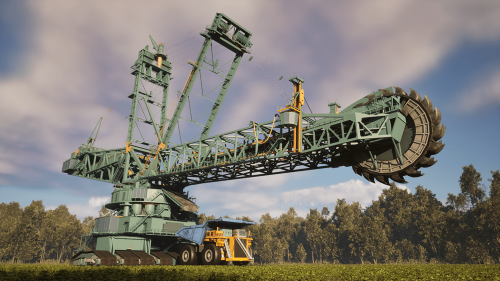
Towering over landscapes like a moving monument of steel, Bagger 293 is not just one of the largest machines ever built—it is a Guinness World Record holder and a true symbol of modern industrial engineering at its most extreme. Manufactured in Germany by engineering giant TAKRAF, this colossal bucket-wheel excavator pushes the boundaries of size, power, and capability.
Bagger 293 stands taller than the Statue of Liberty and weighs more than 80 blue whales combined, making its sheer scale almost difficult to comprehend. Designed specifically for open-pit mining, the machine operates as a mobile excavation factory, capable of moving an astonishing 240,000 cubic meters of earth every single day—enough material to fill nearly 100 Olympic-sized swimming pools in just 24 hours.
At the heart of the machine is its massive 21-meter-wide rotating wheel, fitted with 18 enormous buckets. With every rotation, these buckets scoop and devour vast amounts of soil, rock, and overburden, feeding conveyor systems that transport material efficiently across the mining site. The process is continuous, precise, and relentlessly powerful.
Despite its immense size, Bagger 293 is designed to move. Crawling slowly across terrain and even crossing roads and landscapes, the excavator advances at a carefully controlled pace. Its movement is deliberate but unstoppable, requiring extensive planning and coordination to ensure safety and stability as it reshapes entire environments.
Often mentioned alongside its equally legendary sibling, Bagger 288, Bagger 293 represents the pinnacle of large-scale mechanical design. Together, these machines showcase what is possible when engineering, innovation, and industrial ambition converge.